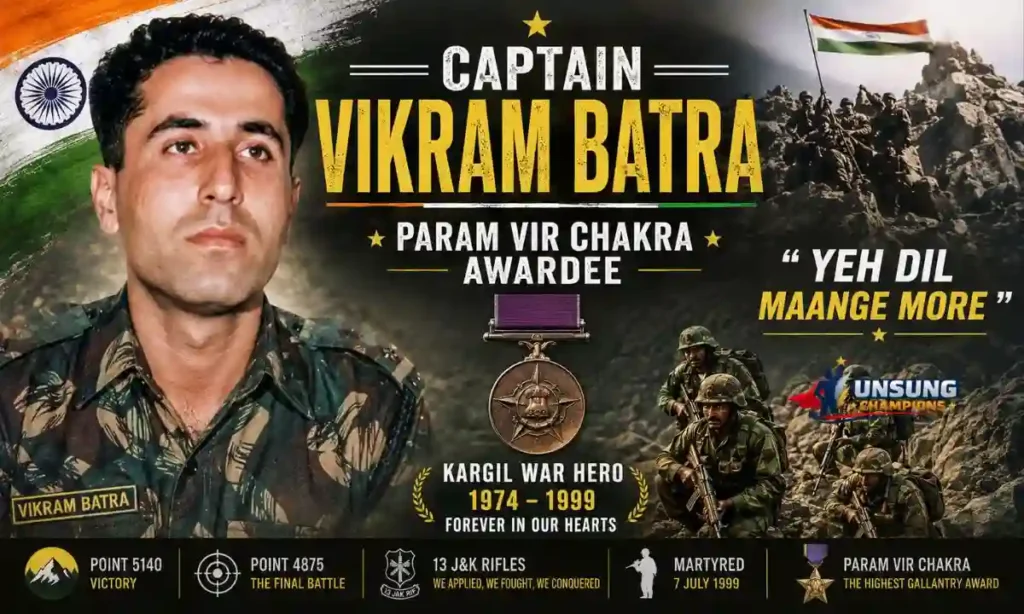
Captain Vikram Batra, PVC is considered as one of the most brave officers of the Indian Army who distinguished themselves through their extreme courage, military skill, and supreme sacrifice in the 1999 Kargil War. Being posted to the 13th Battalion of the Jammu and Kashmir Rifles (13 JAK Rif), Captain Vikram Batra is the awardee of the Param Vir Chakra (PVC) posthumously for his exceptional gallantry, grit, and exemplary leadership during Operation Vijay in Jammu and Kashmir.
Famous throughout the country and among the military ranks as “Sher Shah,” Captain Vikram Batra made an immensely important contribution to the recapture of strategically essential mountaintops in Dras sector from the Pakistani infiltrators particularly Point 5140 and Point 4875. His famous victory message “Yeh Dil Maange More!” spread across the military radio network and became a symbol of determination and fighting spirit of Indian soldiers in the war.
Being born on 9 September 1974 in Palampur, Himachal Pradesh, Vikram Batra exhibited signs of leadership, confidence, good sportsmanship, and dutifulness from an early age. Joining Indian Military Academy in 1996, obtaining his commission in 1997 and sacrificing his life on 7 July 1999 during the battle for Point 4875 of Kargil at age 24, this is the biography of Captain Vikram Batra’s early life, age, family background, education, Army career, Kargil War participation, victory in Point 5140, Point 4875 battle, Param Vir Chakra award, personal life, legacy, and other inspiring facts.
Captain Vikram Batra Biography Overview
| Category | Details |
|---|---|
| Full Name | Captain Vikram Batra |
| Nickname | Sher Shah |
| Date of Birth | 9 September 1974 |
| Birthplace | Palampur, Kangra District, Himachal Pradesh |
| Date of Martyrdom | 7 July 1999 |
| Age at Martyrdom | 24 Years |
| Rank | Captain (Promoted during Kargil War) |
| Service | Indian Army |
| Regiment | 13 Jammu and Kashmir Rifles (13 JAK RIF) |
| Service Years | 1997–1999 |
| War | Kargil War (1999) |
| Operation | Operation Vijay |
| Battles | Battle of Point 5140, Battle of Point 4875 (Batra Top) |
| Gallantry Award | Param Vir Chakra (PVC) |
| Award Status | Posthumous |
| Father | Girdhari Lal Batra |
| Mother | Kamal Kanta Batra |
| Twin Brother | Vishal Batra |
Who Was Captain Vikram Batra?
Captain Vikram Batra was an Indian Army officer who became one of the most revered heroes of the Kargil War of 1999. He belonged to the 13 Jammu and Kashmir Rifles battalion that had a major and crucial role during Operation Vijay.
His heroism, leadership, military tact, and determination under exceptionally difficult conditions of mountain warfare brought him nationwide recognition. In the Kargil conflict, Indian forces needed to recapture high mountain positions occupied by Pakistani troops, and Captain Batra became one of such front-line officers who accomplished such challenging missions of the assault.
The character of Captain Batra included the unique combination of great bravery, military preciseness, and positive disposition. Even in the most difficult combat situations under shelling by artillery, he motivated his soldiers and always led from the front. The actions of Captain Batra in the Points 5140 and 4875 battles made him a legend in the Indian Army, and his supreme sacrifice became one of the best examples of India’s military heroes.
Captain Vikram Batra Age
Captain Vikram Batra was only 24 years old (24 years, 9 months, and 28 days) when he sacrificed his life in the Kargil War.
| Age Details | Information |
|---|---|
| Date of Birth | 9 September 1974 |
| Date of Martyrdom | 7 July 1999 |
| Age | 24 Years |
| Place of Martyrdom | Point 4875 (Batra Top), Mushkoh Valley, Kargil |
| Rank | Captain |
Despite his young age, Captain Batra demonstrated excellent leadership qualities. He was able to achieve such a level of recognition and become a legend in almost two years of Army service.
It means that the age is not the determinant of the leadership; only dedication, rigorous training, and absolute commitment to duty can make heroes.
Captain Vikram Batra Early Life and Childhood
Captain Vikram Batra was born on 9 September 1974 in Palampur, Himachal Pradesh. He was a son of Girdhari Lal Batra, a government school principal, and Kamal Kanta Batra, a school teacher. Owing to deep faith of his mother in the Ramayana, Vikram and his twin brother were nicknamed “Luv” and “Kush.”
Since early childhood, Vikram Batra was known for his active character, confidence, wit, and innate leadership skills. He excelled in sports, studied well, and took part in extracurricular activities, receiving the green belt in Karate and participating actively in table tennis competitions.
His character included a pronounced patriotic feeling since an early age. It was determined by discipline, honesty, and a great desire to wear the uniform and serve the country. Vikram Batra was also known for his great relationship with his twin brother Vishal Batra.
Captain Vikram Batra Family Background
Captain Vikram Batra originated from a humble, educated, and morally sound family from Palampur, Himachal Pradesh.
His parents were important in the formation of his character. His father was a devoted educator and principal, and his mother was also connected with teaching.
| Family Member | Details |
|---|---|
| Father | Girdhari Lal Batra (School Principal) |
| Mother | Kamal Kanta Batra (School Teacher) |
| Twin Brother | Vishal Batra |
| Family Background | Education-oriented, deeply patriotic family from Himachal Pradesh |
Captain Vikram Batra Education
Captain Vikram Batra received his primary education at D.A.V. Public School in Palampur and then studied at the Kendriya Vidyalaya in Palampur. Afterwards, he moved to Chandigarh and entered D.A.V. College, Chandigarh, where he got his B.Sc. degree in Medical Sciences.
While studying in college, he became a member of Air Wing of the National Cadet Corps (NCC), participated in the parade on the Republic Day in New Delhi, and received the NCC ‘C’ Certificate with excellent results. Pursuing his master’s degree in English at Panjab University, he was chosen for the Combined Defence Services (CDS) examination with a dream of joining the Indian Army.
| Education Level | Details |
|---|---|
| School Education | D.A.V. Public School & Kendriya Vidyalaya, Palampur |
| Graduation | B.Sc. Medical Sciences, D.A.V. College, Chandigarh |
| Post-Graduation | M.A. English (Enrolled at Panjab University, Chandigarh) |
| Defence Entry | Combined Defence Services (CDS) Examination |
| Military Training | Indian Military Academy (IMA), Dehradun (Manekshaw Battalion) |
Captain Vikram Batra Indian Army Career
Captain Vikram Batra joined Indian Military Academy (IMA), Dehradun, in June 1996 as a member of the Manekshaw Battalion. Having undergone 18 months of rigorous training, he received his commission in the Indian Army on 6 December 1997 as a Lieutenant of the 13th Battalion, Jammu and Kashmir Rifles (13 JAK Rif).
The initial service in the Army took place at Sopore in the Baramulla district of Jammu and Kashmir, where he performed active operations against insurgents. Within a short period of joining the Army, he proved himself as a courageous and highly skilled tactical leader. In 1999, when the Kargil War started, his battalion was moved to the Dras sector immediately
| Year | Event |
|---|---|
| 1974 | Born in Palampur, Himachal Pradesh |
| 1996 | Joined Indian Military Academy (IMA), Dehradun |
| 6 Dec 1997 | Commissioned as Lieutenant into Indian Army (13 JAK Rifles) |
| 1998 | Deployed in counter-insurgency operations in Sopore, J&K |
| 1999 | Deployed to Dras Sector for Kargil War; Promoted to Captain |
| June 1999 | Led assault team to capture Point 5140 |
| July 1999 | Led assault on Point 4875 |
| 7 July 1999 | Sacrificed his life while rescuing a fellow soldier at Point 4875 |
| 15 August 1999 | Awarded Param Vir Chakra (PVC) posthumously |
Captain Vikram Batra Regiment: 13 Jammu and Kashmir Rifles
Captain Vikram Batra served with the 13 Jammu and Kashmir Rifles (13 JAK Rif), one of the bravest infantry regiments of the Indian Army.
The regiment made an immensely important contribution in the Kargil War under the command of Lt. Col. Y.K. Joshi. Its soldiers were tasked with highly challenging missions of capturing the high-altitude and strategically essential mountaintops. Captain Batra became one of the most recognized personalities of the regiment owing to his fearless leadership during Operation Vijay.
His actions brought great pride to:
- 13 Jammu and Kashmir Rifles
- Indian Army and Infantry Corps
- Himachal Pradesh
- The entire nation
Captain Vikram Batra and Kargil War
The Kargil War of 1999 was conducted between India and Pakistan in the high mountain ranges of Kargil, Jammu and Kashmir, after occupying strategic peaks by Pakistani infiltrators.
During the conflict, Indian soldiers had to conduct frontal assaults on enemy forces that occupied the strategic peaks. These missions were very challenging for Indian soldiers because of:
- High altitude (16,000 to 18,000 feet)
- Steep vertical rock faces and razor-sharp terrain
- Sub-zero temperatures and severe blizzards
- Strongly fortified enemy bunker positions with automatic heavy weapons
Captain Vikram Batra Operation Vijay Role
In the course of Operation Vijay, Captain Vikram Batra commanded his troops from the Delta and Bravo companies in very risky operations of seizing strategic points which provided an overview of the National Highway 1A.
The first strategic breakthrough of Captain Vikram Batra during the Kargil War of 1999 occurred in the night seizure of Point 5140, when his assault team displayed great courage, tactical skill, and the ability to fight in the close quarters. Having completed this successful mission without any casualty among Indian soldiers under his command, his victory message:
“Yeh Dil Maange More!”
transmitted across army radio networks and became a symbol of confidence and determination of Indian people.
Captain Vikram Batra Point 5140 Battle
The seizure of Point 5140 became one of the most remarkable exploits of Captain Vikram Batra during the Kargil War of 1999. Located at an elevation of 17,000 feet, this mountain top had a crucial importance for the enemy because it gave them a direct line of sight to the Srinagar-Leh highway.
Captain Vikram Batra was fighting for 13 Jammu and Kashmir Rifles at this time. His battalion was ordered to seize this very strategically important position under the difficult conditions of mountain warfare on the night of 19-20 June 1999.
Captain Batra decided to attack the peak from the rear side to give a surprise to the enemy. Despite vertical relief of the terrain, intensive enemy machinegun fire, and freezing weather conditions, Captain Batra led his men from the front, threw hand grenades into enemy bunkers, killed enemy gunners in close combat, and seized the position successfully till 0330 hours of 20 June 1999.
Operation to Capture Point 5140
The mission to seize Point 5140 demanded outstanding physical endurance and the element of surprise from Indian soldiers because they had to climb up the rock and to attack the enemy from below the higher position.
Captain Vikram Batra and his team moved ahead strategically, taking advantage of the element of surprise and the cover of the artillery barrage
During the operation:
- Indian assault teams climbed steep cliffs under difficult weather conditions.
- Captain Batra personally led the assault team from the front.
- His team engaged in direct close-quarter combat with heavily fortified enemy posts.
- The objective was successfully captured without a single casualty on his side.
| Detail | Information |
|---|---|
| Operation | Operation Vijay |
| Battle Location | Point 5140, Dras Sector, Kargil |
| Unit | 13 Jammu and Kashmir Rifles |
| Commander | Captain Vikram Batra (Delta Co) & Lt. Sanjeev Jamwal (Bravo Co) |
| Year / Date | 20 June 1999 |
| Result | Decisive Indian victory |
| Importance | Strategic mountain position secured; National Highway protected |
Captain Vikram Batra “Sher Shah” Story
During the Kargil War, Captain Vikram Batra was assigned the radio call-sign “Sher Shah” by his Commanding Officer, Lt. Col. Y.K. Joshi.
The call sign “Sher Shah” (Lion King) symbolized his aggressive nature and bold leadership in the battlefields. The enemy soon realized his voice and radio call-sign, being afraid of his assault teams because of the constant attacks.
Captain Batra earned this legendary reputation because:
- He always led his soldiers from the very front of the assault line.
- He showed exceptional composure under direct enemy artillery and machine-gun fire.
- He motivated his troops constantly during dangerous missions.
- He never hesitated to take tactical risks to ensure mission success.
Captain Vikram Batra Famous Dialogue “Yeh Dil Maange More”
One of the most memorable events of the Kargil War was the victory message of Captain Vikram Batra after seizing Point 5140.
Having completed this successful operation, he sent his message about the victory to his Commanding Officer over the radio saying the following words:
“Yeh Dil Maange More!”
These words instantly spread across India because they perfectly symbolized the spirit, confidence, and courage of Indian soldiers. In the case of Captain Batra, these words expressed his character: having seized one peak, he was ready for the next mission immediately.
The phrase later became an immortal symbol of:
- Courage
- Confidence
- Never giving up attitude
- Absolute patriotism
Captain Vikram Batra Point 4875 Battle
After the success in Point 5140, Captain Vikram Batra and his battalion were given the new mission in Mushkoh Valley—the capture of Point 4875.
Point 4875 was a mountain peak located at an elevation of more than 16,000 feet dominating the northern flank of the Dras sector. This battle was very difficult for Indian forces because of the following challenges:
- Extremely steep, narrow razor-edge rocky ridges
- Sub-zero weather and lack of cover
- Well-entrenched enemy bunkers equipped with heavy automatic weapons and snipers
| Detail | Information |
|---|---|
| Battle | Battle of Point 4875 (Area Ledge) |
| Location | Mushkoh Valley, Kargil |
| War | Kargil War (1999) |
| Unit | 13 Jammu and Kashmir Rifles |
| Commander | Captain Vikram Batra |
| Objective | Recapture strategic peak dominating Mushkoh Valley |
| Result | Indian victory (Peak renamed “Batra Top”) |
| Date of Martyrdom | 7 July 1999 |
Captain Vikram Batra Last Mission
The operation at Point 4875 became the last mission of Captain Vikram Batra. On the night of 6 July 1999, despite being ill from fever and exhaustion, Captain Batra volunteered to command the assault team clearing the dangerous ledge controlled by the enemy.
Attacking the enemy under heavy enemy fire, Captain Batra charged the enemy position, killed five enemies in close combat, and destroyed heavy machine-gun positions.
During the fight in the morning of 7 July 1999, his fellow soldier Subedar Raghunath Singh was badly wounded in the open position. Captain Batra instantly moved to the open and pulled the wounded Subedar into a safe position saying to him: “Tu baal-bacchedaar hai, piche hat… mai khechta hu”. While dragging the Subedar to the safe position and turning to throw a grenade into enemy bunker, he was hit by enemy sniper’s bullet and splinters from an artillery shell, becoming a martyr at age 24.
Captain Vikram Batra Martyrdom
Captain Vikram Batra sacrificed his life during the battle for Point 4875 on 7 July 1999.
His martyrdom was a profound loss for:
- Indian Army
- 13 Jammu and Kashmir Rifles
- His family
- The entire nation
Captain Vikram Batra Last Words
The last moments of Captain Vikram Batra showcased his utmost selfless concern for his troops and the country.
He gave no regard to his own safety throughout the conflict, concentrating exclusively on his task and protecting his men. His last deed proved him to be an exemplary example of a military leader:
- Protecting fellow soldiers before self
- Completing the mission at all costs
- Putting duty and country above life
Captain Vikram Batra Param Vir Chakra Award
For his outstanding gallantry and supreme sacrifice during the Kargil War, Captain Vikram Batra was posthumously awarded the Param Vir Chakra (PVC)—India’s highest wartime military decoration.
| Category | Details |
|---|---|
| Award | Param Vir Chakra (PVC) |
| Recipient | Captain Vikram Batra |
| Award Status | Posthumous |
| War / Operation | Kargil War 1999 / Operation Vijay |
| Reason | Exceptional courage and sacrifice during Point 4875 battle |
| Award Year / Date | Announced 15 August 1999 (Conferred Jan 2000) |
Captain Vikram Batra Param Vir Chakra Citation
The official military citation mentioned his:
- Outstanding personal leadership under direct fire
- Exceptional bravery in close-quarter combat
- Tactical determination under extreme high-altitude conditions
- Supreme self-sacrifice to rescue a fellow soldier and complete the mission
Captain Vikram Batra Family After His Martyrdom
Following the martydom of Captain Vikram Batra, his family kept up his memory and fought for military welfare and encouragement of young Indians.
His parents, Girdhari Lal Batra and Kamal Kanta Batra, were honored with his Param Vir Chakra by President K.R. Narayanan during the Republic Day Parade in January 2000 with great honor. His twin brother Vishal Batra regularly makes speeches across the nation, recounting personal stories of Vikram, his values and duty.
| Family Member | Details |
|---|---|
| Father | Girdhari Lal Batra |
| Mother | Kamal Kanta Batra |
| Twin Brother | Vishal Batra |
| Family Origin | Palampur, Himachal Pradesh |
Captain Vikram Batra and Dimple Cheema Love Story
The love story of Captain Vikram Batra and Dimple Cheema is one of the most touching and revered aspects of his personal life.
They met in 1995 at Panjab University, Chandigarh, and had a strong emotional tie, intending to get married after his return from Kargil. But Vikram’s sacrifice changed everything. Following his supreme sacrifice, Dimple Cheema decided to live without getting married, dedicating her life to Vikram.
Their story represents:
- Pure love
- Absolute commitment
- Loyalty
- Unmatched emotional strength
Captain Vikram Batra and Shershaah Movie
The inspiring story of life of Captain Vikram Batra was immortalized in the Hindi biographical war film “Shershaah”, which came out in 2021.
The movie highlighted:
- His childhood and upbringing in Palampur
- His college days, NCC training, and Army journey
- Tactical Kargil War missions at Point 5140 and Point 4875
- His emotional relationship with Dimple Cheema
- His heroic martyrdom and supreme sacrifice
Captain Vikram Batra Legacy
The legacy of Captain Vikram Batra continues to motivate millions of Indians of all generations.
He is remembered as:
- A brave Army officer and tactical genius
- A fearless battlefield commander
- A loving son and brother
- A loyal friend and partner
- A true national hero
His life stands for values of bravery, sacrifice, patriotism, leadership and selflessness. He is commemorated by the Indian Army as one of its legendary icons.
Captain Vikram Batra Awards and Honours
The unmatched bravery of Captain Vikram Batra during the Kargil War of 1999 brought him immortal glory and national gallantry honors.
| Award/Honour | Details |
|---|---|
| Param Vir Chakra | Awarded posthumously for extraordinary bravery during Kargil War |
| Service Medals | Recognized with operational service medals for Operation Vijay |
| Kargil War Hero Recognition | Nationally venerated for key role in securing Dras sector |
| National Honour | Commemorated permanently across military and civil institutions |
Captain Vikram Batra Memorials and Tributes
As a result of his supreme sacrifice, various landmarks, military stations and educational blocks have been named after Captain Vikram Batra.
| Memorial/Honour | Details |
|---|---|
| Batra Top | Point 4875 officially renamed “Batra Top” by the Indian Army |
| Captain Vikram Batra Block | Named at D.A.V. College, Chandigarh |
| Captain Vikram Batra Chowk | Central memorial location in Palampur, Himachal Pradesh |
| Vikram Batra Hostel & Mess | Named at various educational and defense training institutions |
| Statues and Memorials | Erected in Palampur, IMA Dehradun, and military centers |
| Military Tributes | Commemorated annually during Kargil Vijay Diwas celebrations |
Captain Vikram Batra Kargil Vijay Diwas Tribute
On 26 July of every year, India commemorates Victory of Indian forces in the Kargil War in Kargil Vijay Diwas.
Captain Vikram Batra is among the central figures honored every year on this day. His story is told during military parades and memorial services as well as various educational programs to encourage future generations. Kargil Vijay Diwas is a reminder of
- Soldiers’ unmatched courage
- The supreme sacrifice of military personnel
- The critical importance of national defense
- Unwavering dedication towards duty
Captain Vikram Batra Contribution to Indian Army History
Although Captain Vikram Batra’s service in the Indian Army was less than two years, his contribution has become an integral part of the history of the armed forces. It demonstrated many important leadership traits:
- Fearless Leadership: Leading from the front under heavy direct fire.
- Mission Commitment: Achieving military objectives despite extreme odds.
- Soldier’s Spirit: Keeping troop morale high in life-threatening conditions.
- Selfless Sacrifice: Risking his life to pull a wounded comrade to safety.
Captain Vikram Batra Personality and Character
Besides his outstanding courage on the battlefield, Captain Vikram Batra was noted for his charisma, warmth and strong character. People who knew him describe him as:
- Energetic
- Confident
- Friendly and approachable
- Highly determined
- Courageous
- Helpful and empathetic
Captain Vikram Batra Complete Life Timeline
| Year | Event |
|---|---|
| 1974 | Born on 9 September in Palampur, Himachal Pradesh |
| Childhood | Studied in Palampur; developed leadership, sports, and Karate skills |
| College Years | Completed B.Sc. at D.A.V. College, Chandigarh; earned NCC ‘C’ certificate |
| 1996 | Selected for Indian Military Academy (IMA) via CDS Examination |
| 1997 | Commissioned as Lieutenant into 13 JAK Rifles on 6 December |
| 1998 | Served in counter-insurgency operations in Sopore, J&K |
| 1999 | Deployed to Dras Sector for Kargil War; promoted to Captain |
| June 1999 | Led successful night assault at Point 5140 (“Yeh Dil Maange More!”) |
| July 1999 | Participated in Battle of Point 4875 (Mushkoh Valley) |
| 7 July 1999 | Sacrificed his life while rescuing a wounded comrade at Point 4875 |
| 15 Aug 1999 | Posthumously awarded India’s highest military award, the Param Vir Chakra |
Captain Vikram Batra Unknown Facts
- Captain Batra Was Known as Sher Shah: During the Kargil War, Captain Vikram Batra was given the wireless call-sign Sher Shah by his Commanding Officer, which became feared by enemy forces across intercepted radio frequencies.
- He Was a Young Army Officer: Captain Batra was only 24 years old when he achieved national immortality and earned the Param Vir Chakra.
- He Was a High-Level Athlete: During his school and college days, Vikram Batra actively participated in sports, earned a green belt in Karate, and played table tennis at the national level.
- He Was Selected for Merchant Navy Before Army: Before joining the Indian Army, Captain Batra was selected for a high-paying job in the Merchant Navy (Hong Kong-based shipping company). However, his passion for serving the nation made him choose the Army instead.
- His Twin Brother Shared a Strong Bond With Him: Captain Vikram Batra had a twin brother, Vishal Batra. Born minutes apart, they shared a deep bond and were affectionately called “Luv” and “Kush” by their family.
- He Inspired the Film Shershaah: The 2021 Hindi movie Shershaah was based directly on Captain Vikram Batra’s life, Army journey, romance, and Kargil War sacrifice.
Captain Vikram Batra Famous Quotes and Messages
Captain Vikram Batra was famous for his inspirational attitude. Some of his most memorable statements included:
- “Yeh Dil Maange More!”(His victory signal transmitted after capturing Point 5140, representing his desire to achieve more for the nation.)
- “Either I will come back after raising the Indian flag, or I will return wrapped in it.”(His famous words to a friend before leaving for the Kargil front line.)
- “Tu baal-bacchedaar hai, piche hat… mai khechta hu.”(His last words to Subedar Raghunath Singh while pulling him out of the enemy line of fire.)
Captain Vikram Batra’s Importance for Future Generations
Life story of Captain Vikram Batra shows important lessons about:
- Courage: Performing duty fearlessly even in the face of grave danger.
- Leadership: Standing at the front line with one’s team during difficult times.
- Patriotism: Demonstrating ultimate commitment toward the nation.
- Determination: Overcoming extreme obstacles through focus and conviction.
Captain Vikram Batra Legacy in Indian Youth
Captain Batra remains one of the most inspiring persons for Indian youth who wish to serve in the Armed Forces. His story inspires students and defense aspirants because it stands for:
- Dedication towards the country
- Strong moral values
- Front-line leadership qualities
- Selfless service above self
FAQs
Who was Captain Vikram Batra?
Captain Vikram Batra was an Indian Army officer of 13 Jammu and Kashmir Rifles who received the Param Vir Chakra posthumously for his bravery during the 1999 Kargil War.
When was Captain Vikram Batra born?
Captain Vikram Batra was born on 9 September 1974 in Palampur, Himachal Pradesh.
When did Captain Vikram Batra die?
Captain Vikram Batra sacrificed his life on 7 July 1999 during the Battle of Point 4875 in the Kargil War.
Which award did Captain Vikram Batra receive?
He received the Param Vir Chakra (PVC), India’s highest wartime gallantry award, posthumously.
Why is Captain Vikram Batra called Sher Shah?
“Sher Shah” was his military wireless communication call-sign allocated during Operation Vijay due to his fearless assault tactics.
Which regiment did Captain Vikram Batra belong to?
He served in the 13th Battalion, Jammu and Kashmir Rifles (13 JAK Rif) of the Indian Army.
What was Captain Vikram Batra’s famous slogan?
His most famous phrase was “Yeh Dil Maange More!”, which he used as a success code after capturing Point 5140.
Conclusion
Captain Vikram Batra remains one of the greatest heroes of Indian military history. His bravery in the Kargil War of 1999, especially his participation in the battles of Point 5140 and Point 4875 (Batra Top), made him a national icon.
Being only 24 years old, he demonstrated outstanding tactical leadership and bravery, which encouraged the whole nation. His decision to lead from the front, protect his fellow soldiers and accomplish his mission reflected the best traditions of the Indian Army.
The Param Vir Chakra awardee Captain Vikram Batra continues to live in the hearts of millions of Indians. His story is not just the story of sacrifice of a soldier, but also the story of bravery, commitment, patriotism and perseverance. His famous statement “Yeh Dil Maange More!” continues to stand for his fearless attitude to service of his nation.
Also, Read About: Major Somnath Sharma Biography: First Param Vir Chakra Awardee, Battle of Badgam, Army Career, Family & Legacy