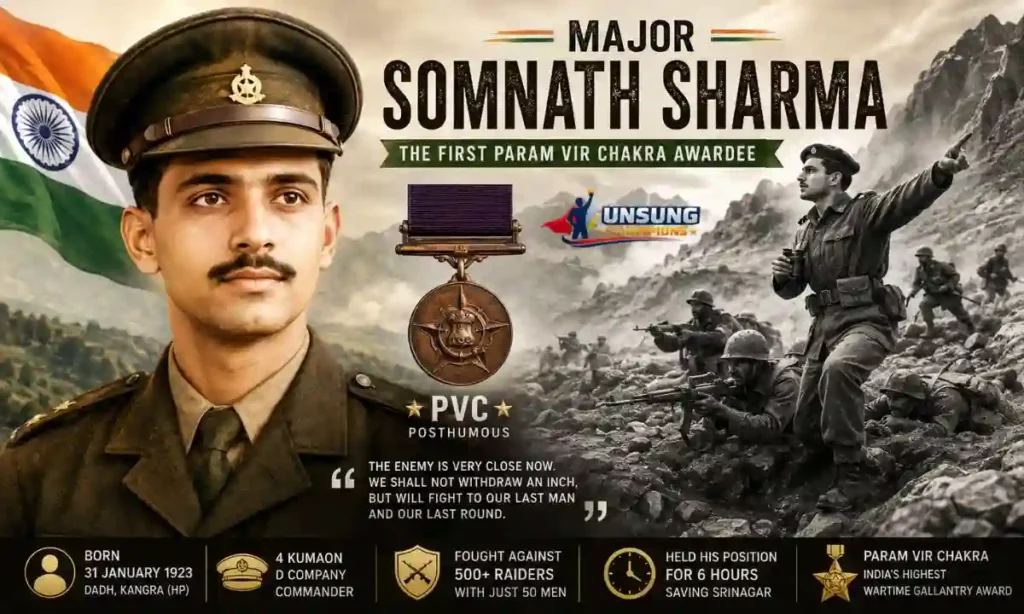
Major Somnath Sharma PVC has become one of the bravest officers of early independent India. He is famous for becoming the first recipient of Param Vir Chakra, the highest war-time bravery award of India. The Param Vir Chakra was posthumously conferred on him for his acts of gallantry during the Battle of Badgam on 3 November 1947. At that time Major Somnath Sharma served with D Company, 4th Battalion, Kumaon Regiment, which had faced a large number of raiders advancing towards Srinagar.
The officer was 24 years old when he made his supreme sacrifice. Notwithstanding the fact that he had his left arm in plaster due to an injury, Major Sharma insisted to go with his men. He personally directed the defence of the company, encouraged his men and helped to keep the flow of ammunition when casualties reduced the company’s strength in the battle. His action delayed the enemy’s advance and gave the precious time for reinforcing the Srinagar defences.
In the current paper we will tell about the biography, age, birthplace, education, family background, Army career, World War II service, 1947 Kashmir conflict, Battle of Badgam, Param Vir Chakra, last stand and legacy of Major Somnath Sharma in detail.
Major Somnath Sharma Biography Overview
| Category | Details |
| Full Name | Major Somnath Sharma |
| Rank | Major |
| Service Number | IC-521 |
| Date of Birth | 31 January 1923 |
| Birthplace | Dadh, Kangra, Himachal Pradesh |
| Date of Martyrdom | 3 November 1947 |
| Age at Martyrdom | 24 years |
| Service | Indian Army |
| Unit | 4th Battalion, Kumaon Regiment |
| Company | D Company |
| Major Battle | Battle of Badgam |
| Conflict | Indo-Pakistani War of 1947–48 |
| Highest Gallantry Award | Param Vir Chakra |
| Award Status | Posthumous |
| Special Distinction | First recipient of the Param Vir Chakra |
| Earlier Recognition | Mentioned in Despatches |
| Father | Major General Amar Nath Sharma |
| Brother | General V. N. Sharma |
According to the National War Memorial database, Major Somnath Sharma had the service number IC-521, his date of birth was 31 January 1923, his rank at the time of his death was Major and the unit was 4th Battalion, Kumaon Regiment. His martyrdom took place at Badgam on 3 November 1947 at the age of 24 years.
Who Was Major Somnath Sharma?
Major Somnath Sharma was an Indian Army officer whose name became permanently associated with courage, leadership and sacrifice during the first Indo-Pakistan conflict of 1947-48.
During the Battle of Badgam Major Somnath Sharma commanded D Company of 4 Kumaon. At that time his company was posted in the Kashmir Valley and it was facing an advancing enemy force that could threaten both Srinagar and its airfield. The latter was extremely important since it was necessary for the delivery of Indian forces and supplies to Kashmir.
On 3 November 1947 the attack of the advancing raiders upon Major Somnath Sharma’s company included approximately 500 fighters while D Company had around 50 men. The enemy launched the attack from three directions, thus creating extremely difficult circumstances for Sharma’s men.
Instead of retreating, the Major organized his company and continued the defence of the position. His actions during these critical hours became the main reason for his being awarded the Param Vir Chakra.
Major Somnath Sharma Age
Major Somnath Sharma was 24 years old at the time of his death.
| Age Detail | Information |
| Date of Birth | 31 January 1923 |
| Date of Martyrdom | 3 November 1947 |
| Age | 24 years |
| Place of Martyrdom | Badgam, Jammu & Kashmir |
| Rank | Major |
This makes his actions during the battle particularly impressive. Indeed, he was still a young officer yet he was assigned with company-level duties at a moment of military crisis.
Major Somnath Sharma Early Life
Major Somnath Sharma was born on 31 January 1923 in Dadh in the Kangra region of present-day Himachal Pradesh. At that time the territory belonged to Punjab Province of British India. He grew up in a family with rich military background.
His father was Major General Amar Nath Sharma, a senior military officer. Several of his siblings also served in the Armed Forces of India. Such military environment fostered in him the values of discipline, responsibility and service from his early years.
Moreover, his grandfather also acquainted him with the values of Krishna and Arjuna from the Bhagavad Gita that are often mentioned in the accounts of his early life and character.
Major Somnath Sharma Family Background
Major Somnath Sharma came from a family distinguished by its glorious military traditions. His father was Major General Amar Nath Sharma, his siblings also became senior military officers. One of them became the Chief of the Army Staff, making the Sharma family especially remarkable in the military history of India.
It should be noted that the family legacy of the Sharma family is particularly remarkable because military service remained in the family across several members and generations. Major Somnath Sharma’s sacrifice in 1947 and his brother’s later achievements as the Army Chief are only two chapters in this remarkable story.
Major Somnath Sharma Family Details
| Family Member | Details |
| Father | Major General Amar Nath Sharma |
| Brother | Lt Gen Surindar Nath Sharma |
| Brother | General Vishwa Nath Sharma |
| Sister | Major Kamla Tewari |
| Family Background | Strong tradition of military service |
Major Somnath Sharma Education
Somnath Sharma received his early education at Sherwood College, Nainital. Later he studied at the Prince of Wales Royal Indian Military College in Dehradun. This college was intended to prepare young people for their future military career. Later Somnath Sharma attended the Royal Military College, Sandhurst, for his officer training.
Major Somnath Sharma Education Details
| Institution | Role in His Education |
| Sherwood College, Nainital | School education |
| Prince of Wales Royal Indian Military College, Dehradun | Military-oriented education |
| Royal Military College, Sandhurst | Officer training |
Major Somnath Sharma Army Career
Major Somnath Sharma was commissioned on 22 February 1942 into the 8th Battalion, 19th Hyderabad Regiment. After the reorganization of the Indian Army his unit was reassigned to 4th Battalion, Kumaon Regiment, with which he served during the Kashmir operations.
The career of Major Somnath Sharma started during the last years of British India and continued during the first years of independent India. This provided him with the experience during two distinct periods of Indian military history.
Major Somnath Sharma Career Timeline
| Year | Major Event |
| 1923 | Born in Dadh, Kangra |
| 1942 | Commissioned into the 8th Battalion, 19th Hyderabad Regiment |
| 1940s | Served during the Arakan Campaign in Burma (World War II); Mentioned in Despatches |
| 1947 | Served with 4 Kumaon during Kashmir operations |
| 3 November 1947 | Fought the Battle of Badgam |
| 3 November 1947 | Made the supreme sacrifice |
| 1950 | Param Vir Chakra award was gazetted posthumously |
Major Somnath Sharma World War II Service
Before his final battle in Kashmir, Major Somnath Sharma had already had the experience of combat during World War II.
He fought against Japanese troops in the Arakan Campaign in Burma. This campaign provided him with the experience of difficult battlefield situation, which later proved to be useful during the Kashmir conflict. His participation in the campaign resulted in the Mention in Despatches.
The previous experience is a very important element of the biography of Major Somnath Sharma because his military career was not limited by the events of 1947. On the contrary, before his Kashmir operations he already had the experience of active military campaign.
Major Somnath Sharma and the 1947 Kashmir Conflict
The situation in Jammu and Kashmir has changed dramatically in October 1947 when armed raiders moved to the region. Srinagar has become a strategically important objective and its airfield was extremely important for delivering the Indian forces to Kashmir.
Major Somnath Sharma’s unit was deployed to Kashmir in this period. His D Company of 4 Kumaon was airlifted to Kashmir and he also participated in the operations in Badgam.
Thus, his mission was not to defend the position but to prevent the advancing enemy force from reaching Srinagar and threatening the airfield.
Major Somnath Sharma Injured Arm
One of the most impressive things about Major Somnath Sharma was that he had already had an injury when his company was deployed.
His left arm was in plaster due to the fracture. However, instead of leaving his unit, he insisted to go with his men. It reflects the military principle that an officer should accompany his men in dangerous operation. His injury did not hinder him from participating in the battle actively.
During the battle when the casualties decreased the efficiency of the light automatic weapons, Major Somnath Sharma personally helped to fill the ammunition magazines and distribute them to the light machine gunners despite his injury in his left arm.
Major Somnath Sharma Battle of Badgam
Battle of Badgam on 3 November 1947 became the critical event in the military career of Major Somnath Sharma.
His D Company of 4 Kumaon was ordered to carry out a fighting patrol in Badgam. Major Somnath Sharma arrived to the area in the morning and established his position there. Later a much larger enemy force launched an attack on his company from three directions.
The numerical difference was enormous.
Battle of Badgam Overview
| Detail | Information |
| Date | 3 November 1947 |
| Location | Badgam, Kashmir |
| Indian Unit | D Company, 4 Kumaon |
| Commander | Major Somnath Sharma |
| Indian Strength | About 50 soldiers |
| Attacking Force | Estimated about 500 raiders |
| Attack | From three sides |
| Strategic Threat | Srinagar and its airfield |
| Major Outcome | Enemy advance delayed |
| Gallantry Award | Param Vir Chakra, posthumous |
Major Somnath Sharma Leadership During the Battle
Major Sharma realized the importance of this situation. If the attacking force managed to break through, the way towards Srinagar and its airfield would become increasingly open.
Therefore, Major Sharma moved from one position to another encouraging his men to fight. Instead of staying in safe place, he repeatedly moved across the open field in order to communicate with his sections.
His leadership had several important aspects:
- He remained with his men despite his fractured arm.
- He personally moved between defensive positions.
- He directed the fire of his sections toward the advancing enemy.
- He helped maintain ammunition supplies.
- He encouraged soldiers when casualties were mounting.
- He continued fighting despite being heavily outnumbered.
- He helped his company hold its position long enough for reinforcements to strengthen the wider defence.
Major Somnath Sharma and the Srinagar Airfield
Defence of Badgam was strategically important because the enemy’s advance threatened Srinagar and the airfield.
According to the official Param Vir Chakra citation, Major Sharma understood the direct threat that would arise if the attack was not held until reinforcements could close the gap towards Srinagar.
Eventually his company delayed the enemy for approximately six hours, giving Indian forces additional time to occupy defensive positions in the Srinagar area.
This delaying action is one of the most impressive results of Major Sharma’s stand. The battle was not only heroic due to Major Sharma’s personal acts but also because the company’s resistance bought the valuable time during the extremely critical period of the Kashmir conflict.
Major Somnath Sharma Last Stand
During the course of the battle, D Company suffered heavy casualties and was under constant fire from the enemy. However, Major Sharma continued directing his men despite deteriorating situation.
He also took measures in order to help aircraft to locate targets by laying cloth strips in the open although this exposed him to enemy fire. This action is specifically mentioned in the citation.
Thus, his acts show that Major Sharma’s leadership included not only his personal bravery but also attempts to coordinate his sections, supply them with ammunition, help to locate targets for the supporting aircraft and motivate his men when his company was under attack from several sides.
How Major Somnath Sharma Died
Major Somnath Sharma was killed in action during the Battle of Badgam on 3 November 1947.
When he was still directing the battle, a mortar shell exploded nearby his position among the ammunition. Thus, he died.
He was only 24 years old.
After that D Company continued resisting and retreated only when it was completely surrounded. According to the official Param Vir Chakra citation, Major Somnath Sharma’s actions helped to delay the enemy for around six hours, allowing Indian reinforcements to strengthen the position in Humhama and stop the advance.
Major Somnath Sharma Param Vir Chakra
For his exceptional courage and leadership during the Battle of Badgam Major Somnath Sharma was posthumously awarded Param Vir Chakra.
He holds the historical record of being the first Param Vir Chakra recipient, the highest military decoration of India for wartime bravery. Major Somnath Sharma’s award was officially gazetted on 21 June 1950 when the decoration was instituted and presented for the first time.
Param Vir Chakra Details
| Award Detail | Information |
| Award | Param Vir Chakra |
| Recipient | Major Somnath Sharma |
| Status | Posthumous |
| Action | Battle of Badgam |
| Date of Action | 3 November 1947 |
| Award Significance | India’s highest wartime gallantry award |
| Historic Distinction | First Param Vir Chakra recipient |
| Gazette Date | 21 June 1950 |
Major Somnath Sharma Legacy
Major Somnath Sharma’s legacy extends far beyond the Battle of Badgam. His name has become associated with the values of courage, leadership, duty and sacrifice in the Indian Armed Forces.
His story is especially significant because it occurred during the formative period immediately after India’s independence. The 1947 Kashmir conflict was one of the first major military challenges faced by the newly independent nation, and the defence of Srinagar became strategically critical.
His sacrifice at Badgam demonstrated how a relatively small force could influence a much larger military situation through determination and leadership.
Major Somnath Sharma Param Vir Chakra Citation
Major Somnath Sharma’s courage during the Battle of Badgam was officially acknowledged with Param Vir Chakra (PVC), posthumously. Major Somnath Sharma became the first Param Vir Chakra recipient in India. His award was based on his exceptional leadership, personal courage and the determination to hold the position despite surrounding and being outnumbered.
His citation reveals that Sharma repeatedly exposed himself to intense enemy fire in order to encourage his men and direct their fire. Even with his arm in plaster he maintained the ammunition supply for his troops. He also arranged the cloth strips to allow friendly aircraft to identify the position and the area.
Major Somnath Sharma Param Vir Chakra Details
| Award Detail | Information |
| Gallantry Award | Param Vir Chakra |
| Award Status | Posthumous |
| Recipient | Major Somnath Sharma |
| Date of Action | 3 November 1947 |
| Battle | Battle of Badgam |
| Unit | D Company, 4 Kumaon |
| Historic Distinction | First Param Vir Chakra awardee |
| Reason | Exceptional courage, leadership and sacrifice |
The Param Vir Chakra made Major Somnath Sharma an integral part of the Indian military history. The deeds of Major Somnath Sharma set the example of battlefield leadership.
Major Somnath Sharma Last Message
The last message of Major Somnath Sharma from the battlefield became one of the most remembered episodes related to the Battle of Badgam. According to the National War Memorial, Major Somnath Sharma reported to his headquarters that the enemy was very close, the company was extremely outnumbered and his men were under intense fire.
The key point of this message was Major Sharma’s determination to not retreat and fight until the last man and the last round.
This message became especially important in the context of Major Somnath Sharma’s legacy because it revealed his decision to make on the battlefield: his company would hold its position as long as possible under extremely heavy attack.
Why Was Major Somnath Sharma’s Battle So Important?
Battle of Badgam was important because it took place during the critical period of the 1947-48 Indo-Pakistan War. The advancing raiders became a threat to Srinagar area and the defence of the Srinagar airfield was strategically extremely important for India because it provided India with means to deliver additional troops and supplies to Kashmir.
Sharma’s company delayed the enemy advance for approximately six hours, providing India with the valuable time to strengthen the approaches to Srinagar.
| Strategic Importance | Major Somnath Sharma’s Contribution |
| Defence of Srinagar | Held the enemy at Badgam |
| Protection of the airfield | Delayed the advancing force |
| Time for reinforcements | Bought several crucial hours |
| Troop morale | Led from the front |
| Battlefield resistance | Continued despite overwhelming odds |
Major Somnath Sharma Family Legacy
Major Somnath Sharma was born in a family distinguished by its military traditions. His father, Major General Amar Nath Sharma served in the Indian Army Medical Services. His siblings also served in India’s military and medical services.
The Sharma family’s military connections have lasted much longer than the lifetime of Major Somnath Sharma. His brother General Vishwa Nath Sharma later became the Chief of the Army Staff, making Sharma family especially notable in India’s military history.
This family background is especially important in order to understand the character of Major Somnath Sharma. Military service was not a strange profession in his family but the tradition of discipline, duty and service were firmly rooted in it.
General V. N. Sharma and Major Somnath Sharma
One of the most notable figures of Major Somnath Sharma’s family was his younger brother General Vishwa Nath Sharma.
General V. N. Sharma eventually became one of the top army generals and served as the Chief of the Army Staff. This contrast between Major Somnath Sharma’s and his brother’s careers becomes especially remarkable in the context of India’s military history. While Major Somnath Sharma became the first Param Vir Chakra recipient due to his supreme sacrifice in 1947, his brother later led the Indian Army at the top professional level.
These stories become the remarkable military legacy of the Sharma family.
Major Somnath Sharma Memorials and Honours
Major Somnath Sharma’s deeds have been remembered with help of various memorials and ceremonies in different regions of India.
The National War Memorial cites several memorials dedicated to Major Somnath Sharma, including bust in the National War Memorial in New Delhi, memorial at Srinagar Airport, and Somnath Sharma Army Ground in Ranikhet. There are roads, parks and residential areas named after him as well.
Major Somnath Sharma Memorials
| Memorial / Honour | Location / Details |
| Bust | National War Memorial, New Delhi |
| Memorial | Srinagar Airport |
| Army Ground | Ranikhet |
| Roads & Parks | Named in his honour at different locations |
| Postal Commemoration | Commemorative stamp and first-day cover |
Major Somnath Sharma at National War Memorial
Major Somnath Sharma is commemorated at the National War Memorial in New Delhi, where his name and sacrifice form part of India’s national record of military service.
His inclusion among the country’s honoured warriors is especially significant because his action occurred during the early years of independent India. His stand at Badgam is remembered as an example of leadership under extreme battlefield pressure.
The memorialisation of Major Sharma is therefore not only about remembering an individual soldier. It also represents the broader sacrifice made by Indian troops during the 1947–48 conflict.
Major Somnath Sharma Interesting Facts
There are several important facts that make Major Somnath Sharma’s biography particularly remarkable.
- Major Somnath Sharma was born on 31 January 1923 in Dadh, Kangra.
- He was commissioned into the Army on 22 February 1942.
- He had previous combat experience from the Arakan operations during World War II.
- He received a Mention in Despatches for his earlier military service.
- His left arm was in plaster when he went into the Kashmir operation.
- He commanded D Company, 4 Kumaon during the Battle of Badgam.
- His company faced an enemy force estimated at around 500 raiders.
- His company consisted of approximately 50 soldiers.
- He continued directing his men despite intense enemy fire.
- He personally helped with ammunition distribution despite his injured arm.
- He was killed at Badgam on 3 November 1947.
- He was only 24 years old at the time of his death.
- He became the first recipient of the Param Vir Chakra.
- His award was given posthumously.
- His brother General V. N. Sharma later became Chief of the Army Staff.
Major Somnath Sharma’s Leadership Lessons
The story of Major Somnath Sharma continues to be relevant because his leadership was demonstrated through actions rather than words alone.
Lead From the Front
Major Sharma did not remain away from danger while his men were fighting. Despite his injured arm, he went into the operational area and remained with his company.
Never Abandon Responsibility
The Battle of Badgam placed his company in an extremely difficult position. Instead of withdrawing immediately, he understood the larger responsibility of delaying the enemy’s movement toward Srinagar.
Courage Under Pressure
The numerical difference between the two forces was enormous. Yet Sharma continued to organise the defence and encourage his men.
Duty Before Personal Safety
His actions demonstrated an uncompromising commitment to duty. His final stand became the defining example of his military career and ultimately led to his posthumous Param Vir Chakra.
Major Somnath Sharma Legacy in Indian Military History
Major Somnath Sharma’s name occupies a special position in Indian military history because he combined personal bravery with strategic responsibility.
His sacrifice at Badgam helped delay the enemy’s advance at a crucial moment. The time gained allowed Indian forces to strengthen their positions around Srinagar, making his company’s stand important beyond the immediate battlefield.
His legacy can be understood through three major elements:
- Courage: He continued fighting despite being seriously outnumbered.
- Leadership: He remained physically present with his troops and directed their defence.
- Sacrifice: He ultimately gave his life while fulfilling his responsibility as a commanding officer.
FAQs
Who was Major Somnath Sharma?
Major Somnath Sharma was an Indian Army officer of 4 Kumaon who fought during the Battle of Badgam in 1947. He became the first recipient of the Param Vir Chakra, India’s highest wartime gallantry award.
When was Major Somnath Sharma born?
Major Somnath Sharma was born on 31 January 1923 in Dadh, Kangra, in present-day Himachal Pradesh.
How old was Major Somnath Sharma when he died?
He was 24 years old when he was killed in action on 3 November 1947.
Which regiment did Major Somnath Sharma belong to?
He served with the Kumaon Regiment, and during the Battle of Badgam he commanded D Company, 4th Battalion, Kumaon Regiment.
Which award did Major Somnath Sharma receive?
He was awarded the Param Vir Chakra posthumously for his extraordinary courage and leadership during the Battle of Badgam. He was the first recipient of the award.
Where did Major Somnath Sharma die?
Major Somnath Sharma was killed in action at Badgam, Jammu and Kashmir, on 3 November 1947.
What happened at the Battle of Badgam?
Major Sharma’s company of approximately 50 soldiers faced an estimated 500 raiders. His troops held their position for several crucial hours, delaying the enemy’s movement toward Srinagar.
Conclusion
Major Somnath Sharma represents one of the earliest and most powerful examples of military courage in independent India’s history. From his upbringing in a military family and education at prestigious institutions to his World War II experience, his career reflected a strong commitment to military service.
But it was his final stand at Badgam on 3 November 1947 that made his name immortal. Despite having an injured arm and facing an enemy force many times larger than his company, he remained with his men and continued directing the defence until his death.
His sacrifice helped buy crucial time for the defence of Srinagar, while his extraordinary conduct earned him the Param Vir Chakra posthumously, making him India’s first recipient of the nation’s highest wartime gallantry award.
Also, Read About: Major Rishima Sharma Biography: Army Career, Husband Major Mohit Sharma, Family, Ashoka Chakra & Life Story