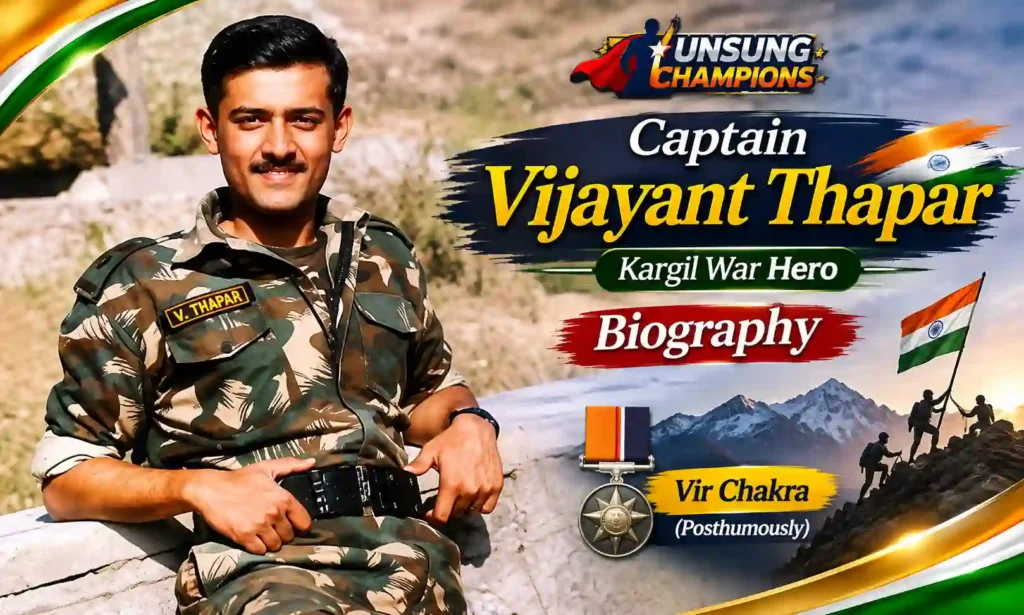
Captain Vijayant Thapar was an Indian Army officer who sacrificed his life during the Kargil War of 1999. He served as a Captain in the 2nd Battalion of the Rajputana Rifles and gained recognition due to his bravery and courage during military operations in the Dras sector. He was only 22 years old at the time of his death in the Battle of Knoll. For his bravery, he received the Vir Chakra posthumously.
Vijayant Thapar was born on 26 December 1976 in Naya Nangal, Punjab. He was born into a military family and grew up with the ambition of becoming a soldier in the Indian Army. His childhood name was Robin, which was special for his family members.
Although Vijayant Thapar is mainly remembered as a brave soldier, some aspects of his character can be traced in his kind attitude towards Ruksana and his last letter to his parents. Moreover, his memory was preserved by his family after the war by their visits to the battlefield and publication of the book Vijyant at Kargil. Twenty-plus years since the Kargil War, his story is still remembered and shared by his family members and those who knew him personally.
Who Was Vijayant Thapar?
Captain Vijayant Thapar was an Indian Army officer who participated in the Kargil War of 1999. He was associated with the 2nd Battalion of the Rajputana Rifles and was involved in military operations aimed to reclaim mountain heights held by Pakistani troops.
The officer received his commission in the Indian Army on 12 December 1998 after graduating from the Indian Military Academy at Dehradun. He was assigned to serve with 2 Rajputana Rifles based in Gwalior. Then, the unit was redeployed to Kashmir for operational assignments and further to the Kargil sector.
Vijayant Thapar took part in the Battle of Tololing and the Battle of Three Pimples. However, his bravery and leadership during the battle around Knoll became a part of his military legacy. Captain Vijayant Thapar died in action during the Battle of Knoll in June 1999.
His bravery was posthumously recognized by the Vir Chakra award. Now, he is not only a Kargil War martyr but also a young officer known for his values such as kindness and compassion to people.
Vijayant Thapar Biography – Quick Information
| Particulars | Details |
|---|---|
| Full Name | Vijayant Thapar |
| Popular Name | Robin |
| Rank | Captain |
| Profession | Indian Army Officer |
| Date of Birth | 26 December 1976 |
| Birthplace | Naya Nangal, Punjab, India |
| Age at Martyrdom | 22 Years |
| Nationality | Indian |
| Father | Colonel Virender N. Thapar |
| Mother | Tripta Thapar |
| Brother | Vijender Thapar |
| Military Training | Indian Military Academy, Dehradun |
| Commissioning Date | 12 December 1998 |
| Regiment / Battalion | 2 Rajputana Rifles |
| Operation | Operation Vijay |
| War | Kargil War, 1999 |
| Rank at Martyrdom | Captain |
| Date of Martyrdom | 28–29 June 1999 (sources differ) |
| Place of Martyrdom | Knoll, Dras Sector, Kargil |
| Gallantry Award | Vir Chakra (Posthumously) |
| Famous For | Courage during the Kargil War and his final letter |
| Biography Book | Vijyant at Kargil |
| Nickname Symbol | Robin Bird |
Vijayant Thapar Age, Date of Birth and Birthplace
Vijayant Thapar was born on 26 December 1976 in Naya Nangal, Punjab. The boy grew up in a military family where discipline, responsibility, and devotion to military service were common elements.
He was only 22 years old at the time of his death during the Kargil War in June 1999. Although his military career was quite brief, his heroism during the conflict is a part of the memories of his family members and the Indian Army.
| Birth Details | Information |
|---|---|
| Date of Birth | 26 December 1976 |
| Birthplace | Naya Nangal |
| State | Punjab |
| Country | India |
| Age at Martyrdom | 22 Years |
| Birth Year | 1976 |
| Year of Martyrdom | 1999 |
Vijayant Thapar Early Life and Childhood
Vijayant Thapar grew up in a military family. His great-grandfather, grandfather and father served in the army before him. Thus, he was the fourth generation of the military family to serve in the Indian Army.
According to the recollections of his father, Colonel Virender Thapar, Vijayant was always interested in military activities. When he was still a little boy, he used to wear his father’s peak cap and cane and pretended to be an army officer.
Moreover, Vijayant played pretend wars with his younger brother where he was representing India. All of these memories later become the examples of his childhood behaviour and personality.
From his childhood, Vijayant was quite energetic, active, and interested in physical exercises. Unlike many boys from military families, he was not forced to become a soldier. Instead, Vijayant decided himself to become an officer in the army. His family supported his choice, and the boy started preparing for his military career.
Vijayant Thapar Family Background
As mentioned above, Vijayant Thapar came from a military family where several generations of his relatives served in the army. This background was important for him to choose his career path in life.
His father, Colonel Virender N. Thapar, had a significant influence on his life. His mother, Tripta Thapar, supported him during his education and military career. His younger brother, Vijender Thapar, also grew up in the military family and helped to preserve the memory of his death after it happened.
After the death of their son, his family continued his story by participating in interviews, school visits, various events, and annual trips to the Kargil battlefield.
| Family Member | Name | Details |
|---|---|---|
| Father | Colonel Virender N. Thapar | Retired Indian Army officer |
| Mother | Tripta Thapar | Supported his military journey |
| Brother | Vijender Thapar | Younger brother |
| Great-Grandfather | Name not publicly established here | Served in the armed forces |
| Grandfather | Name not publicly established here | Served in the armed forces |
Father: Colonel Virender N. Thapar
Colonel Virender N. Thapar is the father of Captain Vijayant Thapar. He served in the Indian Army and encouraged his son to pursue his dream of becoming an officer.
After the death of his son, Colonel Thapar dedicated a lot of time to preserving the memory of Captain Vijayant Thapar. He participates in interviews and visits the Dras battlefield in order to recall the place where his son died.
His annual visits to the Kargil region have become the family tradition. According to ThePrint, in 2025 due to health issues caused by heart surgery, he could not make his annual trip to the battlefield. Then, his younger son, Vijender, went to Dras in his place.
Mother: Tripta Thapar
Tripta Thapar is the mother of Captain Vijayant Thapar. She told about the boy’s childhood, personality and military career in several media reports.
For his mother, the death of Vijayant is a source of both pride and grief. Tripta described how hard it is to go back to the place where her son died.
Nowadays, the family preserves the memory of Captain Thapar by keeping his belongings, letters and photographs. His mother talked about his kindness and his relationship with Ruksana whom he helped during his stay in Kashmir.
Brother: Vijender Thapar
Vijender Thapar is the younger brother of Captain Vijayant Thapar. He has been participating in the family’s activities dedicated to keeping his brother’s memory alive.
In 2025, when the father could not visit the Kargil battlefield due to health problems, Vijender paid a visit to the Dras battlefield in his place. This was reported by ThePrint as the part of their article on the family’s tradition of visiting the battlefield.
Vijayant Thapar Education and Military Training
Vijayant Thapar prepared himself to serve in the Indian Army since his childhood. The military family he came from shaped his ambitions, but he also needed to complete the necessary preparations to enter the army and receive professional training.
He successfully passed the entrance tests and became a student of the Indian Military Academy (IMA) in Dehradun, one of the best institutions providing education and training of Army officers. During his studies, he got ready for the military assignments he was going to do later.
Having graduated from the academy, Vijayant received his commission on 12 December 1998. After that, he joined 2 Rajputana Rifles and began his military career as a commissioned officer.
| Education and Training | Details |
|---|---|
| School Education | Detailed school records not publicly established |
| Military Academy | Indian Military Academy |
| Academy Location | Dehradun, Uttarakhand |
| Training | Army officer training |
| Commissioning Date | 12 December 1998 |
| First Unit | 2 Rajputana Rifles |
Why Did Vijayant Thapar Join the Indian Army?
Vijayant Thapar’s choice of joining the Indian Army was determined by his family’s military background and his childhood dreams of becoming a soldier.
Both his father, grandfather and great-grandfather served in the army before him. His childhood surrounded by stories, uniforms and military discipline gave him the chance to build his relation with the profession.
According to his father, Vijayant did not need to be convinced to join the army. He made this decision from childhood and his passion was reflected in his preparation for the Indian Military Academy and his attempts to become an officer.
His choice was not a mere continuation of his family’s traditions because the last letter also shows how much Vijayant believed in his choice of career and in the mission of protecting his motherland.
Vijayant Thapar Military Career and Commissioning
Vijayant Thapar was commissioned into the Indian Army on 12 December 1998 after his successful graduation from the Indian Military Academy.
His first assignment was in 2 Rajputana Rifles in Gwalior. He was posted to the battalion in 1998 and served there for a short period of time before it moved to Kashmir for operational assignments.
At first, Vijayant performed counter-insurgency operations where he was exposed to difficult field conditions and operational tasks.
In Kashmir, he took part in the encounters with militants. Such experience gave him an opportunity to understand his responsibilities as a leader of soldiers in the dangerous situation.
The Kargil conflict started before Vijayant’s career in the army could develop much. As a result, his battalion was redeployed to the Dras sector where he took part in the operations against the enemy positions on mountain heights.
Regiment, Rank and Army Service
Captain Vijayant Thapar served with the 2nd Battalion of the Rajputana Rifles, commonly called 2 Raj Rifles. This battalion performed well during the operations in the Kargil War.
According to the information provided in Honourpoint’s service profile, his service number was IC-58278M, and he was associated with the Army Service Corps. The first operational unit of Vijayant Thapar was 2 Rajputana Rifles.
| Military Information | Details |
|---|---|
| Service Number | IC-58278M |
| Rank | Captain |
| Service | Indian Army |
| Regiment / Battalion | 2 Rajputana Rifles |
| Arm Listed in Honourpoint Profile | Army Service Corps |
| Commissioning | 12 December 1998 |
| First Posting | Gwalior |
| Operational Assignment | Kashmir and Kargil |
| Operation | Operation Vijay |
His service record should be viewed through the distinction between the arm recorded in it and the infantry battalion with which he served.
Vijayant Thapar in the Kargil War
The Kargil War took place in 1999 after the occupation of strategic mountain heights by the Pakistani soldiers and armed personnel on the Indian side of the Line of Control in the Kargil region of Jammu and Kashmir.
To regain control of these heights and expel Pakistani forces from the Indian territory, the Indian Army organized the operation known as Operation Vijay. Difficult terrain and high altitude increased the difficulties of the military operations.
Captain Vijayant Thapar’s battalion, 2 Rajputana Rifles, was redeployed to the Dras sector where they were supposed to fight against the enemy occupying the strategically important mountain heights.
During the war, Captain Vijayant Thapar took part in the operations against the enemy positions on mountain heights of Dras as a young officer whose task was to lead the soldiers in a difficult situation. His participation in the assault on Barbad Bunker and subsequent battle at Knoll became the important part of his wartime record.
The Kargil conflict challenged the physical endurance, military skills, and leadership of soldiers operating at high altitude. Captain Thapar continued to lead his men during these operations despite the danger.
Role of Vijayant Thapar in the Battle of Tololing
Tololing is the strategically important mountain height during the Kargil War. It became one of the main objectives of the Indian Army during the operation Vijay.
The Battle of Tololing was the operation where the Indian soldiers had to perform assaults on the enemy positions located at high altitude. The soldiers had to pass the open mountain terrain under fire.
Captain Vijayant Thapar and his battalion took part in the operations in the area of Tololing. His involvement in the assault on Barbad Bunker became the part of the battalion’s operations.
According to the story published by IIT Kanpur, his platoon played a role in the capture of Barbad Bunker during the night of 12 June 1999. This event contributed to the efforts of the Indian Army to reclaim the Tololing.
Eventually, the Indian Army recaptured Tololing on 13 June 1999. It became an important turning point in the Kargil War.
Barbad Bunker Operation
The Barbad Bunker operation was one of the first important missions of Captain Vijayant Thapar during the Kargil War.
His platoon was tasked to perform an assault against the enemy position, known as Barbad Bunker on the Tololing height. It was important because the enemy could control the approaches to this strategically important point from this position.
The operation entailed passing the difficult mountain terrain under fire and attacking enemy positions in close combat. Captain Thapar led his men during the assault.
The capture of Barbad Bunker was important for the Indian Army to recapture Tololing. This event became the example of the contribution of 2 Rajputana Rifles in the battle.
Thus, the Barbad Bunker operation is the important part of his biography as the event where his contribution to the Kargil War was made before the battle of Knoll.
Battle of Three Pimples and Knoll
After the operations in the Tololing, 2 Rajputana Rifles was assigned to continue performing operations in the Dras sector. They had to recapture the Three Pimples, Knoll and Lone Hill.
Enemy positions on the mountain heights were strategically important, and their capture was a difficult task requiring coordinated actions of infantry units in difficult conditions.
Captain Vijayant Thapar was assigned to lead his platoon during this assault. His task was to guide his men to the enemy positions and face the fire.
The battle at Knoll was especially difficult for Captain Thapar. According to the military story and the report by ThePrint, Captain Thapar continued to advance against the enemy positions and encourage his soldiers to attack them.
During the assault, he was hit by enemy fire and received fatal wounds. His company commander, Major Padmapani Acharya, and his orderly, Jagmal Singh, were also killed during the operation, according to ThePrint.
Finally, the Knoll was captured by the Indian soldiers after the fierce battle. Captain Thapar’s actions during the assault became the part of the record of his gallantry which led to the posthumous Vir Chakra award.
How Was Captain Vijayant Thapar Martyred?
Captain Vijayant Thapar was martyred during the Battle of Knoll in the Dras sector of Kargil in June 1999.
He was leading his platoon during the assault on the enemy positions when he was hit by enemy fire. Despite the difficult situation, Indian soldiers continued the operation and eventually managed to capture the objective.
There is a slight discrepancy in published accounts. Honourpoint’s service profile and his gallantry citation indicate 28 June 1999, while the report by ThePrint and other sources indicate his death as 29 June 1999. All the accounts discuss the same final battle at Knoll, however, they differ in dates of the operation and the moment of his death.
For this reason, it is safer to indicate that Captain Vijayant Thapar died during the night of 28-29 June 1999, rather than give one of the dates as correct without any additional explanation.
He was 22 years old when he was martyred during the Kargil War.
Vijayant Thapar Vir Chakra Award and Official Citation
Captain Vijayant Thapar was awarded the Vir Chakra posthumously for his heroism and leadership during the Kargil War.
The Vir Chakra is the third-highest wartime gallantry award in India. It recognizes acts of bravery performed in the presence of the enemy on land, sea or air.
The official citation mentions his role in leading his platoon during the assault on enemy positions. It describes his determination to advance under heavy fire and efforts to motivate his men during the assault.
His bravery and leadership during the Battle of Knoll were recognized with the Vir Chakra award. His actions became the examples of the responsibilities and dedication expected from an Army officer.
It should be noted that the Vir Chakra is a different award than Param Vir Chakra. The mistake about Captain Thapar receiving the Param Vir Chakra was made in some of the secondary online articles.
| Award Details | Information |
|---|---|
| Award | Vir Chakra |
| Award Status | Posthumous |
| Recipient | Captain Vijayant Thapar |
| Conflict | Kargil War, 1999 |
| Operation | Operation Vijay |
| Associated Unit | 2 Rajputana Rifles |
| Reason | Courage and leadership during the assault on Knoll |
Captain Vijayant Thapar’s Last Letter
One of the best-known facts from the life of Captain Vijayant Thapar is his last letter written to his parents before his final mission. It was a very personal message reflecting his views about the war dangers and his devotion to both the Army and his family.
In the letter, he expressed his pride in the services rendered by him for his country and asked his parents to come to the battlefield where the Army fought and asked his unit to remember the sacrifices made by the Army during the operation.
There were several personal requests in his letter. He asked his family members to contribute money to an orphanage and to continue helping a little girl called Ruksana whom he met during his posting in Kashmir.
The last sentence in his letter was “Live life King Size”. This sentence became very famous later on as a representation of his character and personality and the way his family members remember him.
The letter has been kept by his family members and has been cited in many reports and articles written about Captain Vijayant Thapar. According to ThePrint, there is a huge framed copy of his letter which is placed at the entrance of his family house.
His Message to His Parents
Vijayant’s last letter reflects his idea that military service requires personal sacrifice and responsibility towards others.
He asked his parents to remember the battlefield where his unit fought and asked them to make sure that the young soldiers of his unit remember the sacrifices.
In his message, he expressed that, if given a chance to live another life, he would have joined the Army once again and would have served his country again. This idea became one of the most popular points in his last message.
His Request for Ruksana
In the letter written by Captain Vijayant Thapar to his parents, he asked them to provide financial help to a young girl named Ruksana whom he met during his posting in Kashmir. He asked his parents to help her financially by contributing ₹50 per month.
His family members honored this request after his death and continued helping her financially for many years.
Robin: The Story Behind Vijayant Thapar’s Nickname
Robin was the nickname used for young Captain Vijayant Thapar in his childhood. This nickname was given to him by his father, Colonel Virender Thapar.
According to the report by his father, the baby was moving arms and legs very actively in the hospital crib. This scene reminded his father of a little bird and he started addressing the baby as Robin.
Although his official name was Vijayant Thapar, this nickname remained popular in his family. All family members used this nickname till the end of his life.
This bird became the sign of remembrance for his family after his death. They collected various objects like paintings and photographs depicting robins.
Vijayant Thapar and Ruksana: A Story of Kindness
The most touching story in connection with Captain Vijayant Thapar is the story about the young Kashmiri girl Ruksana.
During his posting in Kupwara, Kashmir, Vijayant noticed a little girl who never spoke or laughed. She was five or six-year-old.
On inquiries, he found out that the girl had seen killing of her father by terrorists and this incident traumatized her.
He started to communicate with her, talked to her, gave her sweets and toffees.
According to the report by his mother Tripta Thapar, Ruksana began to speak and laugh again after his meetings with her.
Captain Thapar developed special attitude towards this girl’s welfare. He wanted to provide some help and continuation of her education.
How Captain Thapar Helped Ruksana
The relationship between Captain Vijayant Thapar and Ruksana is characterized by compassion and concern for a little girl who faced a tragedy.
He realized that she needed not only emotional but practical assistance. Therefore, he started communicating with her by holding talks with her and giving her something.
Before the last operation, he asked his parents to send her ₹50 every month. This request can be found in his last letter to his family members.
His family members continued to help her financially and provided her with educational opportunities.
Ruksana’s Life After Captain Thapar’s Death
Family members of Captain Vijayant Thapar didn’t forget about Ruksana after his death and continued to provide her financial help.
According to the report by Hindustan Times published in 2018, Ruksana studied in Class 12 and wanted to go to college. According to the Hindustan Times report published in July 2024, she completed her college studies and prepared for her marriage.
According to ThePrint report published in June 2025, the Thapar family kept in touch with her, helped her with her education and attended her wedding ceremony.
This story of continued assistance demonstrates how Captain Thapar’s last request turned into a responsibility of his family members.
Vijayant Thapar Personality, Discipline and Hobbies
Captain Vijayant Thapar was a very energetic and friendly young man, as his family members remembered him.
His father told that he had a good kind attitude and willingness to help others. As his family members say, he was very uncomfortable seeing people suffering and sometimes he gave his pocket money to the needy people.
Captain Thapar lived a disciplined life. His family remembered his interest in physical activity, fitness exercises and swimming.
He liked music. His favorite song was “Sandese Aate Hain” from the movie Border. This song became closely connected with his memory.
This information about his hobbies reveals that he liked ordinary activities although he was devoted to his military service.
| Personal Interests | Details |
|---|---|
| Nickname | Robin |
| Favourite Song | Sandese Aate Hain |
| Favourite Film Connection | Border |
| Hobby | Swimming |
| Fitness | Regular exercise and physical training |
| Religious Interest | Devoted follower of Hanuman, according to family reporting |
| Personality | Friendly, disciplined and helpful |
| Personal Values | Courage, kindness and service |
Vijayant Thapar’s Father and the Annual Kargil Visit
One of the most emotional components of the legacy of Captain Vijayant Thapar is the annual visit to the battlefield where he fought his last battle, made by his father, Colonel Virender Thapar.
Colonel Thapar made such visits for many years to the places called Dras and Knoll. He considered these places his pilgrimage sites because his son died here.
These visits were also a way of fulfilling the request from the last letter of Captain Vijayant Thapar to come to the battlefield where the Indian Army fought for their country.
The family members also took part in remembrance activities related to the Kargil Vijay Diwas celebrated every year on 26th July.
In 2025, according to ThePrint, Colonel Thapar could not make his usual annual visit because of health problems caused by heart surgery. So his younger brother, Vijender, visited Dras instead of him.
The family keeps the legacy of Captain Vijayant Thapar by telling his story through interviews, school programs and other events. The main idea of these programs is the demonstration of not only his military courage but also kindness and responsibility.
Vijyant at Kargil: The Book About His Life
Vijyant at Kargil is a biography of Captain Vijayant Thapar written by his father, Colonel V. N. Thapar, and Neha Dwivedi.
This book was published in 2020 and describes Vijyant’s life: his childhood, military training, family background and the experience gained during the Kargil War.
The author includes the memories of the family members and people who knew Vijyant. This book allows readers to understand better the personality of this young captain who lived his life as a soldier.
This book is very important since it helps to save personal memories which will not be included in military documentation. Moreover, it reveals how the family members of Vijyant felt his death and how they remember him.
The article published by Penguin Random House India in May 2020 introduced his life and final days in this book.
Vijayant Thapar Memorial and Legacy
Memory of Captain Vijayant Thapar is being kept by his family, Army community and all people remembering the Kargil War.
The family home of Captain Thapar in Noida is full of photographs, medals, letters and other belongings. According to ThePrint, his old bedroom was transformed into a memorial room with such things as his swimming goggles, cassette player and Army uniform.
Also, there is an outdoor gallery of photographs and other belongings of this young hero. His last letter is exhibited as a reminder of his requests.
The road in Noida is named as Vijayant Thapar Marg and the name of his family home is Vijayant Enclave. Such memorial names keep his name alive in the city of his childhood.
His legacy is also kept through the story about Ruksana, the book Vijyant at Kargil and the participation of his family in remembrance events.
Vijayant Thapar Latest Updates in 2026
Captain Vijayant Thapar news 2026 are mostly connected with his family’s recollections about his life and death, his participation in the Kargil War and the efforts made by his relatives to support his last wish to help Ruksana continue her education.
According to ThePrint, the most detailed family recollections about Captain Thapar were published on 11 June 2025. They described annual visits of Colonel Virender Thapar to Dras and his health problems that prevented him from visiting in 2025. Instead of their father, his younger son Vijender Thapar visited Dras in that year.
Moreover, his family continues to take care of Ruksana as it had been agreed by his parents. The Print also reported that they went to her wedding ceremony and that Captain Thapar’s personal belongings are preserved in the family.
His biography Vijyant at Kargil is one of the main sources describing his life and career. The book about the young officer’s military life in 2020 was written by his father Colonel V. N. Thapar and Neha Dwivedi.
None of the news published recently was independently confirmed as new 2026 development about his memorial, his family and Ruksana. For this reason, the latest available family news are given with their original publication dates and are not labelled as new 2026 developments.
Lesser-Known Facts About Vijayant Thapar
- Vijayant Thapar was born on 26 December 1976 in Naya Nangal, Punjab.
- His childhood nickname was Robin.
- He was the fourth generation of his family to serve in the Indian Army.
- His father was Colonel Virender N. Thapar.
- He joined the Indian Military Academy in Dehradun.
- He was commissioned into the Army on 12 December 1998.
- His first posting was with 2 Rajputana Rifles at Gwalior.
- He served in Kashmir before being deployed to the Kargil sector.
- He participated in operations around Tololing and Barbad Bunker.
- He led his platoon during the assault on Knoll.
- He was 22 years old when he was killed in action.
- He received the Vir Chakra posthumously.
- He asked his parents to continue supporting a young girl named Ruksana.
- His final letter included the phrase “Live life King Size.”
- He loved swimming and enjoyed physical fitness.
- His favourite song was “Sandese Aate Hain” from Border.
- His father co-authored the book Vijyant at Kargil in 2020.
- His family has continued visiting Dras to remember his sacrifice.
Frequently Asked Questions
Who was Vijayant Thapar?
Vijayant Thapar was an Indian Army Captain who served with 2 Rajputana Rifles during the 1999 Kargil War. He was killed in action during the Battle of Knoll and received the Vir Chakra posthumously.
What was Vijayant Thapar’s age when he died?
He was 22 years old when he was killed during the Kargil War in June 1999.
What was Vijayant Thapar’s date of birth?
He was born on 26 December 1976 in Naya Nangal, Punjab.
Who was Vijayant Thapar’s father?
His father was Colonel Virender N. Thapar, a retired Indian Army officer.
Who was Vijayant Thapar’s mother?
His mother’s name was Tripta Thapar.
What was Vijayant Thapar’s nickname?
His nickname was Robin. His father gave him the name when he was a newborn.
Which regiment did Vijayant Thapar serve in?
He served with the 2nd Battalion of the Rajputana Rifles, commonly known as 2 Rajputana Rifles.
Final Words
The life of Captain Vijayant Thapar was short but his contribution to the Kargil War became an important part of military history of India. He joined the Army driven by his childhood dream, received necessary training and took part in the Kargil War as a part of 2 Rajputana Rifles.
His sacrifice at Knoll and the award Vir Chakra reflect his courage as a soldier but also his personality and the principles he believed in. His attempts to help Ruksana and the last request to his parents become a part of the personal legacy of Captain Vijayant Thapar.
The story about his life has been preserved by his family because of the book Vijyant at Kargil, annual visits to Dras and published stories. Therefore, the story about Captain Vijayant Thapar becomes a record of military heroism and human values.
Also, Read About: Charulatha Remesh Biography 2026: Age, Education, Career & Husband