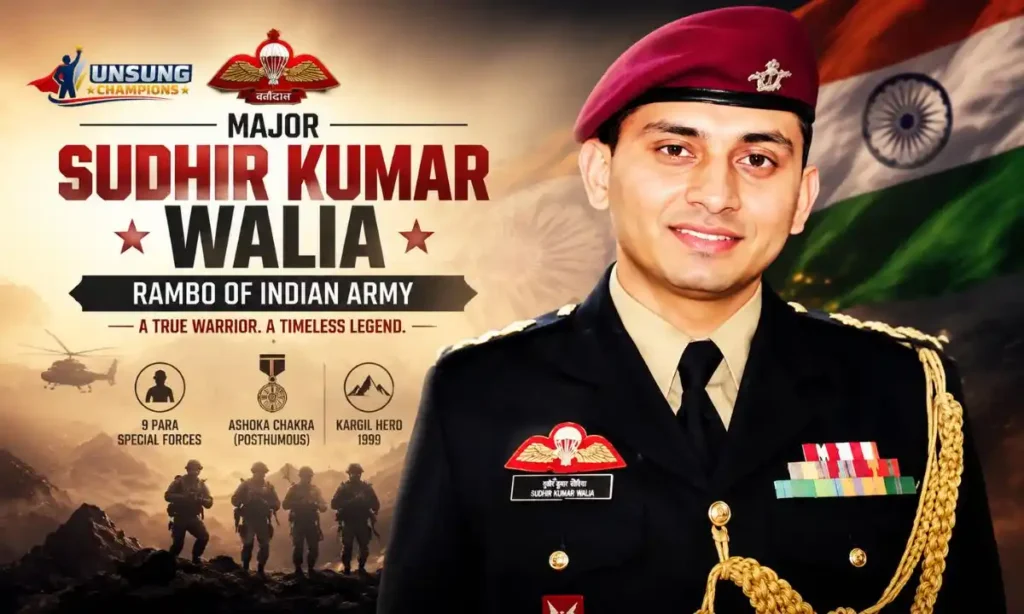
Major Sudhir Walia, AC, SM & Bar, ADC is widely regarded as one of the bravest soldiers of Indian Army and is known as a legendary officer of the 9 Para Special Forces. The fearless Major is nicknamed as “Rambo of Indian Army” by his fellow soldiers and has given his entire life for protecting the motherland.
Coming from an army background, Major Sudhir Walia was greatly inspired by discipline, courage and patriotism from a very young age. His story from an ordinary student at Sainik School to an elite Special Forces soldier illustrates his determination and hard work for the motherland.
In his entire military career, he has been involved in numerous counter-insurgency operations, served in extreme conditions like Siachen Glacier, has made huge contributions in the Kargil War (Operation Vijay) and ultimately laid down his life during a terrorist strike in Haphruda forest in Kupwara, Jammu & Kashmir in 1999. In recognition of his bravery, he was awarded the Ashoka Chakra award posthumously.
Learn the complete biography of Major Sudhir Walia, a fearless 9 Para Special Forces officer of Indian Army. Know all about his age, family background, marital status, Indian Army career, Kargil War bravery, Ashoka Chakra award and supreme sacrifice.
Major Sudhir Walia Biography Overview
| Details | Information |
| Full Name | Major Sudhir Kumar Walia |
| Rank | Major |
| Service | Indian Army |
| Unit | 9 Para (Special Forces) |
| Other Regiment | 4 Jat Regiment |
| Nickname | Rambo of Indian Army |
| Date of Birth | 24 May 1968 |
| Birthplace | Jodhpur, Rajasthan |
| Hometown | Banuri, Palampur, Himachal Pradesh |
| Date of Martyrdom | 29 August 1999 |
| Place of Martyrdom | Haphruda, Kupwara, Jammu & Kashmir |
| Service Period | 1988–1999 |
| Awards | Ashoka Chakra (Posthumous), Sena Medal, Bar to Sena Medal |
| Known For | Special Forces Operations & Kargil War Bravery |
Who Was Major Sudhir Walia?
Major Sudhir Walia was a highly decorated officer of Indian Army and has served in its elite Special Forces unit, 9 Para (Special Forces). Due to his fearless attitude, physical prowess and combat leadership, he has been widely acknowledged as “Rambo of Indian Army” by his fellow soldiers.
Unlike many officers of Indian Army who preferred taking command away from the combat zone, Major Walia always wanted to remain with his troops during field operations. His brave attitude has been evident throughout his career, be it counter-terrorism operations in Jammu & Kashmir, tough conditions of Siachen Glacier or high altitude warfare in the Kargil War.
Not only has he been an excellent soldier but also a courageous leader who was more concerned about setting example through his own deeds.
Major Sudhir Walia Age and Date of Birth
Major Sudhir Walia was born on 24 May 1968. While he was born in a military hospital in Jodhpur, Rajasthan but belonged to the Banuri village of Palampur in Kangra District, Himachal Pradesh.
Coming from an Army background, his childhood was influenced a lot by military discipline and patriotism. His father’s military service played an important part in deciding his career and making him join the military service as well.
He laid down his life on 29 August 1999 at the age of 31 years while commanding his troops during an operation against terrorists in Kupwara, Jammu & Kashmir.
| Age Details Category | Information & Specific Details |
| Date of Birth | 24 May 1968 |
| Birthplace | Jodhpur, Rajasthan (At a Military Hospital) |
| Hometown | Banuri, Palampur, Himachal Pradesh |
| Age at Martyrdom | 31 Years |
| Date of Martyrdom | 29 August 1999 |
Early Life and Childhood
Major Sudhir Walia’s childhood took place in an environment that was dominated by discipline, courage and patriotism. As his father had served in Indian Army, his childhood was greatly influenced by this noble profession.
Since childhood, he was a boy with qualities like determination, physical fitness and good leadership skills. At first, he went to a local Government school in his village Banuri but then joined the prestigious Sainik School in Himachal Pradesh.
It was his experience at Sainik School that helped him build confidence and instill military discipline in him.
| Early Life Category | Information & Background |
| Father | Subedar Major Rulia Ram Walia |
| Mother | Rajeswari Devi |
| Village / Hometown | Banuri, Palampur, Himachal Pradesh |
| Schooling | Sainik School Sujanpur Tihra |
| Inspiration | Strong Military Family Background & Patriotic Upbringing |
Major Sudhir Walia Family Background
As stated above, Major Sudhir Walia belonged to a proud military background. His father Subedar Major Rulia Ram Walia served in Indian Army and played a crucial role in shaping his disciplined character.
Having grown up in a military family enabled him to understand the values of service, sacrifice and responsibility from an early age itself.
| Family Member | Name / Relation Details |
| Father | Subedar Major Rulia Ram Walia (Retd. Indian Army) |
| Mother | Rajeswari Devi |
| Brother | Arun Walia |
| Sister | Bindiya Walia |
| Marital Status | Unmarried (Dedicated his entire life to national service) |
Major Sudhir Walia Education
Major Sudhir Walia initially received his early education from Government School Banuri before going ahead and joining the Sainik School, Sujanpur Tihra.
The experience that he had at Sainik School was crucial in developing his confidence and leadership skills. After completing his schooling, he joined the National Defence Academy (NDA) in 1984 at the age of 16 years.
Later, he completed his officer’s training at Indian Military Academy (IMA) Dehradun and was ready for a successful career as an Army officer.
| Qualification Level | Institution Name & Location |
| School Education | Government School Banuri |
| Military Schooling | Sainik School Sujanpur Tihra, Himachal Pradesh |
| Defence Training | National Defence Academy (NDA), Khadakwasla |
| Officer Training | Indian Military Academy (IMA), Dehradun |
Major Sudhir Walia Joining Indian Army
After completing his training from IMA Dehradun, Major Sudhir Walia was commissioned into Indian Army on 11 June 1988 as a 2nd Lieutenant in 4th Battalion of The Jat Regiment (4 Jat).
Initially, his service in Indian Army provided him with immense operational experience that included participating in Indian Peacekeeping Force (IPKF) mission in Sri Lanka.
During this phase of his service, he got his first exposure to the real combat situations and developed a great passion for performing special operations behind enemy lines.
Major Sudhir Walia Army Career Timeline
| Year / Phase | Career Milestone & Achievements |
| 1968 | Born in Jodhpur, Rajasthan |
| 1984 | Joined National Defence Academy (NDA) at age 16 |
| 1988 | Commissioned into 4 Jat Regiment (11 June 1988) |
| Early Career | Served in Sri Lanka during the IPKF Mission |
| Later Years | Completed probation and joined 9 Para Special Forces |
| 1994 | Received Sena Medal for Gallantry in Jammu & Kashmir |
| 1997 | Appointed as Aide-de-Camp (ADC) to Army Chief Gen. V.P. Malik |
| 1999 | Rejoined unit and participated in Kargil War (Zulu Top) |
| 29 August 1999 | Martyred during Haphruda Forest Operation in Kupwara |
Major Sudhir Walia and 9 Para Special Forces Journey
The Indian Army career of Major Sudhir Walia attained a new height when he joined the elite Special Forces unit 9 Para (Special Forces).
The Para Special Forces is amongst the most elite combat units of Indian Army which is formed for conducting special operations in extreme conditions.
Due to his dedication, physical strength, mental toughness and excellent combat skills, Major Sudhir Walia turned out to be one of the most respected officers of his unit.
Service in 9 Para (SF) unit demands exceptional qualities in soldiers as its soldiers have to conduct operations behind enemy lines, conduct counter-terror missions and face situations where bravery and quick decisions are highly required.
What Is 9 Para Special Forces?
The 9 Para (Special Forces) is one of the most elite special operations units of Indian Army and is commonly referred to as “Mountain Mavericks”. It is trained to perform high risk missions that demand extreme physical fitness, advanced combat skills and tactical expertise.
The unit specializes in:
- Counter-terrorism operations
- Special reconnaissance missions
- High-altitude warfare
- Direct action operations
- Hostage rescue missions
- Intelligence-based clandestine operations
| Particular | Details |
| Unit Name | 9 Para (Special Forces) |
| Force | Indian Army Special Forces |
| Role | Special Operations & Direct Action |
| Main Operations | Counter Terrorism & High-Risk Combat Missions |
| Known For | Elite Mountain Warfare & Combat Capability |
Special Forces Training and Transformation
Becoming an officer of Para Special Forces is considered one of the toughest tasks in Indian Army. The probation and training of a Special Forces officer focuses not only on the physical capability but also on extreme mental strength, survival skills and leadership under fire.
Major Sudhir Walia has gone through intense training and emerged as one of the finest Special Forces officers after that.
The training included:
- Advanced weapon handling and marksmanship
- Jungle warfare and survival tactics
- Mountain warfare and rock climbing
- Survival techniques behind enemy lines
- Unarmed close-combat training
- Long-range tactical patrolling
- Clandestine night operations
Dedication and commitment has made him an outstanding member of Special Forces fraternity.
Major Sudhir Walia’s Siachen Deployment
During his Army career, Major Sudhir Walia also served in tough conditions of Siachen Glacier, the world’s highest battlefield.
Siachen is known for:
- Extreme sub-zero cold temperatures (dropping below -50°C)
- High altitude conditions causing oxygen deprivation
- Difficult treacherous terrain with deep crevasses
- Continuous operational challenges and enemy artillery shelling
Deployment in Siachen Glacier requires immense physical and mental strength. Major Sudhir Walia has served there successfully and has gained immense experience in high altitude warfare.
This experience proved to be beneficial for him in later missions that included his service in Jammu & Kashmir and Kargil War as well.
Major Sudhir Walia as ADC to Army Chief
One of the prestigious positions held by Major Sudhir Walia in his military career has been that of the Aide-de-Camp (ADC) of Army Chief General Ved Prakash Malik.
A position of ADC is given to only such officers who are highly capable and trusted for their professionalism and communication skills.
During this period, Major Walia handled key responsibilities including:
- Assisting the Army Chief in official duties
- Coordinating high-level military activities
- Understanding higher-level Army strategic operations
- Supporting official state and diplomatic engagements
While having a comfortable job at Army Headquarters, Major Sudhir Walia always remained connected to his identity as a combat soldier.
During the Kargil War in 1999, he kept requesting permission from General V.P. Malik for going back to active duty with his Special Forces unit instead of remaining at New Delhi. He reportedly told General V.P. Malik as follows:
“I am used to leading my men from the front, not sitting in headquarters.”
His request was granted owing to his love for active combat.
Major Sudhir Walia’s Role in Kargil War
Kargil War of 1999 was amongst the most notable wars fought by Indian Army in modern times. At the time of the war, Major Sudhir Walia was serving in 9 Para Special Forces.
Although he was ADC of the Army Chief at that time, he wanted to take part actively in the battle field. Getting approval from the Army Chief, he joined his unit for performing combat operations in Kargil.
Bravery and leadership during the Kargil conflict has been one more noteworthy part of his military career.
Zulu Top Operation During Kargil War
At the time of Kargil War, Major Sudhir Walia played a crucial role in operations around Zulu Top of the Mushkoh Valley region.
The mission involved:
- Fighting against heavily positioned enemy forces in fortified bunkers
- Operating in extremely difficult mountainous terrain at high altitude
- Conducting strategic night assaults to surprise enemy posts
- Supporting Indian Army objectives during Operation Vijay
Mountain warfare is one of the toughest types of warfare as the soldiers have to fight not only against enemy forces but also harsh natural environment. This made the experience and bravery of Major Sudhir Walia more significant during these operations.
Sena Medal and Bar to Sena Medal
Major Sudhir Walia has been awarded multiple awards for his exceptional bravery and services in Indian Army throughout his career.
| Award Name | Honor & Details |
| Sena Medal | Awarded in 1994 for gallantry and distinguished service in Kashmir |
| Bar to Sena Medal | Additional recognition for continued bravery in special operations |
| Ashoka Chakra | Awarded posthumously for supreme sacrifice in Haphruda forests |
These awards speak volumes about the exceptional level of bravery displayed by Major Sudhir Walia in his entire military career.
Major Sudhir Walia’s Leadership Qualities
Major Sudhir Walia was respected not only because of his combat skills but also because of his leadership qualities.
Fearless Approach
He never hesitated in taking up tough missions and always volunteered for the most dangerous tactical duties.
Leading From The Front
Being amongst the best military leaders, he believed in facing risks alongside his soldiers.
Strong Determination
His determination could be understood from his decision to quit prestigious ADC job at Army HQ and return to combat during Kargil War.
Commitment Towards Nation
All of his decisions in career were motivated by his firm commitment towards nation.
Why Major Sudhir Walia Was Called “Rambo of Indian Army”
Major Sudhir Walia was called “Rambo of Indian Army” because of his amazing physical abilities, fearlessness, and exceptional work in risky situations.
The nickname represented:
- His aggressive yet calculated bravery during combat missions
- His high-level Special Forces tactical expertise
- His legendary stamina to survive in hostile environments
- His ability to lead from the front under heavy enemy fire
He was considered a military man who embodied the real essence of an invincible Special Forces warrior by the other soldiers.
Major Sudhir Walia Career Highlights
| Achievement / Event | Operational Details |
| Commissioned | 11 June 1988 into Indian Army |
| First Unit | 4th Battalion, The Jat Regiment (4 Jat) |
| Special Forces Unit | 9 Para (Special Forces) |
| Siachen Service | Deployed in extreme high-altitude glacier conditions |
| Kargil War | Led successful high-altitude assault on Zulu Top (Operation Vijay) |
| ADC Role | Served with Army Chief General Ved Prakash Malik |
| Gallantry Awards | Sena Medal, Bar to Sena Medal |
| Highest Honour | Ashoka Chakra (Posthumously awarded in 2000) |
Haphruda Operation: Major Sudhir Walia’s Final Mission
The most significant chapter in Major Sudhir Walia’s career occurred when he participated in the counter-terror operation in the Haphruda forests in the Kupwara district of Jammu & Kashmir. This mission was the last time when the Major showed great courage, leadership, and supreme dedication to his duty.
Being a member of 9 Para (Special Forces), he was sent on the operation against the well-equipped foreign terrorists who were hiding in the Haphruda forest area. For his fearlessness, Major Sudhir Walia personally led his assault team in this risky environment.
His work in this operation explains why Major Walia was recognized as one of the best officers of the Indian Army.
Background of Haphruda Operation
In August 1999, just after the end of the Kargil War, the intelligence agencies found out that a group of about 15-20 foreign militants trained in combat were hiding in the dense Haphruda forests of Kupwara.
An operation was organized in order to find and kill these terrorists. Due to the hard conditions of the forest territory and the possibility of the heavy resistance, the mission required an elite Special Forces person.
Thus, Major Sudhir Walia, who was an elite officer of 9 Para Special Forces, was chosen to perform this mission.
| Particular | Details |
| Operation Area | Haphruda Forests, Kupwara, Jammu & Kashmir |
| Date of Operation | 29 August 1999 |
| Unit Deployed | 9 Para (Special Forces) |
| Operation Type | Intelligence-Based Counter-Terrorism Mission |
| Objective | Neutralize heavily armed foreign terrorists |
| Commander | Major Sudhir Walia |
Major Sudhir Walia Led From The Front
During this operation, Major Sudhir Walia proved the real qualities of a Special Forces officer. Instead of waiting in a secure place, he went to the front line of his squad acting as the point man.
Special Forces operations require:
- Precise stealth planning
- Silent movement in thick foliage
- Quick decision-making under fire
- Supreme courage under pressure
- Complete trust between team members
Thanks to his rich experience of participating in operations, Major Sudhir Walia helped his squad to navigate through the hazardous forest environment. His leadership inspired the other soldiers to keep going even in the face of severe danger.
The Fierce Encounter With Terrorists
During the mission, Major Sudhir Walia crawled to the hideout of the terrorists to count their numbers. Suddenly, the terrorists opened fire to the advancing commandos.
But Major Sudhir Walia quickly rushed to the hideout and took the initiative into his own hands. Within some minutes, he killed two terrorists in a close-range.
Despite the heavy enemy fire, Major Sudhir Walia continued to command his team with incredible coolness
- Complete the mission objective successfully.
- Protect his squad members from casualties.
- Eliminate the remaining terrorist threat completely.
Major Sudhir Walia’s Supreme Sacrifice
During the fierce battle with the terrorists in the Haphruda forest, Major Sudhir Walia was wounded critically by the gunfire in his face and abdomen.
Even in such conditions, Major Sudhir Walia did not want to be evacuated. For more than half an hour he held his position giving tactical commands until all nine terrorists were eliminated in this sector and his team was completely secured.
Before falling unconscious from his injuries, Major Sudhir Walia reported to his commanding officer with his famous last words: “Sir, I have taken care of the enemy.”
Major Sudhir Walia made the supreme sacrifice on 29 August 1999 at the age of 31
| Particular | Details |
| Name | Major Sudhir Kumar Walia |
| Date of Martyrdom | 29 August 1999 |
| Location | Haphruda Forests, Kupwara, Jammu & Kashmir |
| Unit | 9 Para (Special Forces) |
| Operation | Counter-Terrorism Operation Haphruda |
| Status | Martyred in Action (Achieved Veergati) |
Ashoka Chakra Award
For his exceptional courage, tactical leadership, and supreme sacrifice, Major Sudhir Walia was posthumously awarded with the Ashoka Chakra which is the highest peacetime gallantry award of India in 2000 during the Republic Day.
The award recognized his:
- Outstanding personal bravery during combat.
- Fearless leadership under extreme enemy fire.
- Refusal to step back despite sustaining mortal injuries.
- Unmatched devotion towards national duty.
The Ashoka Chakra immortalized Major Sudhir Walia as one of the best military heroes of India.
| Particular | Information |
| Award Name | Ashoka Chakra |
| Award Type | Highest Peacetime Gallantry Award of India |
| Recipient | Major Sudhir Kumar Walia |
| Award Status | Posthumous (Conferred on 26 January 2000) |
| Reason | Exceptional Courage & Supreme Sacrifice in Kupwara |
Major Sudhir Walia Awards and Honours
During his military career, Major Sudhir Walia was honored with several prestigious awards for his bravery and skillful work.
| Award / Honor | Details & Context |
| Ashoka Chakra | Awarded posthumously for supreme sacrifice in 1999 |
| Sena Medal | Awarded in 1994 for gallantry in anti-terror operations |
| Bar to Sena Medal | Second gallantry recognition for continuous bravery |
| ADC Appointment | Selected as ADC to COAS Gen. Ved Prakash Malik |
Major Sudhir Walia Family Details
Major Sudhir Walia belonged to a famous defence family in Himachal Pradesh. His father, Subedar Major Rulia Ram Walia, served in the Indian Army and greatly contributed to instilling the deep sense of military in his son.
Such family background provided him with good lifelong values of discipline, duty, and patriotism.
| Family Member | Name & Background |
| Father | Subedar Major Rulia Ram Walia |
| Mother | Rajeswari Devi |
| Brother | Arun Walia |
| Sister | Bindiya Walia |
The family of Major Walia still remains respected all over the country because of the brave act of their son.
Major Sudhir Walia Wife
There is always the interest of the people in the private life and marital status of Major Sudhir Walia.
Major Sudhir Walia was unmarried. He devoted his youth fully to his military training, his missions in the 9 Para Special Forces, and protection of his motherland. There is no much information about the personal life of the Major in public sources.
Legacy of Major Sudhir Walia
The legacy of Major Sudhir Walia inspires the soldiers, the army officers, and the youth of India.
His life represents:
- Courage Beyond Limits: He accepted the toughest military challenges without fear.
- Commitment Towards Duty: He always placed national service far above personal comfort.
- Special Forces Excellence: His career represents the highest standards of professionalism in the Indian Armed Forces.
- Inspiration For Youth: Young defence aspirants study his life as a model of leadership and selflessness.
Why Major Sudhir Walia Is Remembered as Rambo of Indian Army?
The nickname “Rambo of Indian Army” shows the fearlessness and outstanding battlefield abilities of the Major.
He earned this reputation because:
- He served in 9 Para SF, one of India’s toughest military units.
- He led high-risk counter-terror operations from the front.
- He fought fearlessly in extreme environments like Siachen Glacier and Kargil.
- He displayed unmatched courage and eliminated enemy threats even while mortally wounded.
Lesser Known Facts About Major Sudhir Walia
- Major Sudhir Walia was born on 24 May 1968 in Jodhpur, Rajasthan.
- His native ancestral village was Banuri in Palampur, Himachal Pradesh.
- He received his military schooling at Sainik School Sujanpur Tihra.
- He joined the National Defence Academy (NDA) at the young age of 16 in 1984.
- He was commissioned into the 4 Jat Regiment in 1988 before joining 9 Para (SF).
- He served with the IPKF mission in Sri Lanka during the late 1980s.
- He served as ADC to Army Chief General Ved Prakash Malik but chose to return to the battlefield during Kargil.
- He led the critical assault on Zulu Top during the 1999 Kargil War.
- He was awarded the Ashoka Chakra posthumously in 2000.
- He is fondly remembered across India as the “Rambo of Indian Army”.
Major Sudhir Walia Salary
Major Sudhir Walia was a military person of the Indian Army in the late 1980s and 1990s. Thus, his salary was regulated by the government pay scale under the Fifth Central Pay Commission.
As an Army officer, Major Sudhir Walia had a base salary along with some allowances for the military service, the high altitude, and commando duties.
| Salary Category | Official Structure & Scale Details |
| Rank | Major |
| Organization | Indian Army |
| Unit | 9 Para (Special Forces) |
| Service Period | 1988–1999 |
| Pay Scale Basis | 5th Pay Commission Scale for Army Officers |
| Allowances | High Altitude Allowance, Special Forces Pay, Military Service Pay |
Unlike the commercial celebrities, the identity of Major Sudhir Walia was fully formed by his noble service, courage, and sacrifice but not his financial condition.
Major Sudhir Walia Net Worth
There is no financial net worth of Major Sudhir Walia.
During his life, his financial condition was regulated by the standard military pay system and he dedicated himself to the defense of the motherland fully. His real wealth was the respect and honor, his legacy, Ashoka Chakra which he won by his supreme sacrifice.
| Category | Overview Details |
| Financial Net Worth | Not Applicable (Military Officer) |
| Profession | Indian Army Special Forces Officer |
| Main Income Source | Official Defence Salary & Army Allowances |
| True Legacy | Ashoka Chakra, National Respect & Heroic Legacy |
Major Sudhir Walia Social Media Presence
Major Sudhir Walia lived in the epoch when modern digital social networks did not appear. Thus, he did not have any personal social media accounts.
Nowadays, there are thousands of patriotic people, the defense aspirants, and Indian Army tribute pages who publish his stories and videos to commemorate him.
| Platform | Current Status / Tribute Presence |
| Numerous tribute pages maintained by patriotic citizens | |
| Fan pages and Indian Army memorial posts available | |
| X (Twitter) | Official tributes by ADG PI – Indian Army on martyrdom days |
| YouTube | Documentary films and biography tribute videos available |
Major Sudhir Walia’s Contribution to Indian Army
The contribution of Major Sudhir Walia to the Indian Army lies much further than the operations which he performed personally. Major Sudhir Walia embodied the supreme standards of bravery, tactical mastery, and dedication to the duty of a Special Forces officer
His major contributions include:
- Serving with distinction in the 4 Jat Regiment during the early phase of his career.
- Volunteering and clearing probation for the elite 9 Para Special Forces.
- Participating in counter-terrorism operations across Jammu & Kashmir.
- Serving under extreme high-altitude conditions at Siachen Glacier.
- Playing a vital role in capturing Zulu Top during the Kargil War (Operation Vijay).
- Leading from the front during the historic Haphruda forest counter-terror operation.
Leadership Lessons From Major Sudhir Walia
The life of Major Sudhir Walia teaches us some timeless leadership lessons.
1. Lead From The Front
The Major believed that the commander should go to the front line of danger. Thus, he was the point man of his assault teams during the operations.
2. Never Give Up Against Difficulties
He never gave up against the extreme coldness in Siachen, the steep heights in Kargil, or the dense jungle in Kupwara. Major Sudhir Walia faced every difficulty with unshakable mental power.
3. Duty Comes First
The decision of the Major to give up the comfortable role of the ADC at the Army HQ and fight on the front line during the Kargil War showed his devotion to the duty.
4. Courage Creates Inspiration
The bravery of Major Sudhir Walia inspires thousands of defense aspirants who want to wear the maroon beret of the Special Forces.
FAQs
Who was Major Sudhir Walia?
Major Sudhir Walia was an elite Indian Army officer of 9 Para (Special Forces) who was posthumously awarded the Ashoka Chakra for exceptional courage during a counter-terrorism operation in Jammu & Kashmir in 1999.
Why is Major Sudhir Walia called Rambo of Indian Army?
He earned the title “Rambo of Indian Army” because of his extraordinary physical endurance, fearless personality, tactical expertise in 9 Para SF, and exceptional courage displayed in dangerous combat operations.
When was Major Sudhir Walia born?
Major Sudhir Walia was born on 24 May 1968.
Where was Major Sudhir Walia from?
He belonged to Banuri village in Palampur, Kangra district, Himachal Pradesh.
Was Major Sudhir Walia married?
No, Major Sudhir Walia was unmarried. He dedicated his life entirely to his military duty and national service.
Which Special Forces unit did Major Sudhir Walia serve in?
He served in the elite 9 Para (Special Forces) unit of the Indian Army.
Conclusion
The life story of Major Sudhir Walia is the excellent example of courage, dedication, and patriotic spirit. His path of life starting from Sainik School Sujanpur Tihra and ending up with the status of one of the best officers of the Indian Army shows the dedication of this man to India.
His participation in the risky operations like Kargil War, the Siachen glacier deployment, and counter-terrorism missions created the legend of one of the finest officers of the history of Indian Army.
The last mission in Haphruda forests and the supreme sacrifice of Major Sudhir Walia on 29 August 1999 were rewarded with the nation’s highest peacetime gallantry award—the Ashoka Chakra.
Being known forever as “Rambo of Indian Army,” Major Sudhir Walia continues to inspire the soldiers, defense aspirants, and each citizen of India who respects bravery and sacrifice.
Also, Read About: Brigadier Hoshiar Singh Biography: Age, Family, Army Career, Sela Pass Battle & Heroic Story