
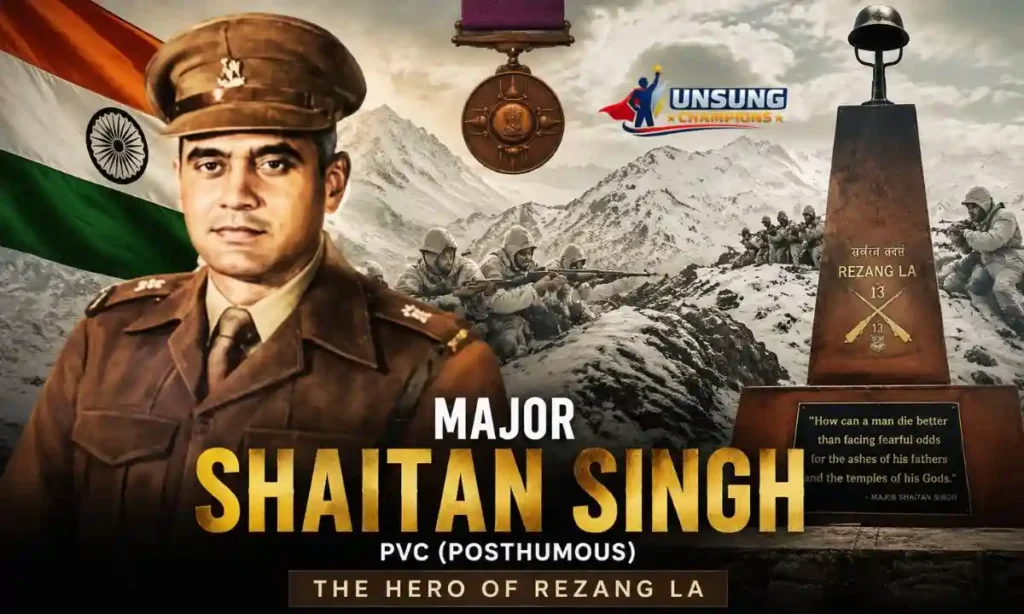
While some great figures are remembered for living long lives, others have become legends due to their self-sacrifice for the sake of their Motherland. One of such great officers is Major Shaitan Singh Bhati, who gained legendary status for his outstanding feat during the Battle of Rezang La in the 1962 Sino-Indian War. Being in charge of C Company of the 13 Kumaon Regiment, the Major was able to encourage his soldiers to resist the Chinese attacks even in the most difficult weather conditions. His great bravery and heroic sacrifice was later rewarded by the Param Vir Chakra award.
UnsungChampions.com is dedicated to telling the stories of India’s unsung heroes and legendary warriors. In this biographical essay, you will get to know about the early life of the great Major Shaitan Singh, his military career, family, wife, Battle of Rezang La, Param Vir Chakra, legacy and other interesting facts taken from verified historical sources.
The heroic deeds of Major Shaitan Singh are still admired by the officers of the Indian Army, military historians and millions of Indians today. This outstanding personality’s great contribution to the Indian army ensured that his memory will always be remembered by the people.
Major Shaitan Singh Biography Overview
| Details | Information |
| Full Name | Major Shaitan Singh Bhati |
| Popular Name | Major Shaitan Singh |
| Rank | Major |
| Regiment | 13 Kumaon Regiment |
| Service Number | IC-6400 |
| Profession | Indian Army Officer |
| Date of Birth | 1 December 1924 |
| Birthplace | Banasar, Jodhpur State (Present-day Rajasthan), British India |
| Nationality | Indian |
| Religion | Hindu |
| Community | Bhati Rajput |
| Father | Lt. Col. Hem Singh Bhati (Jodhpur State Forces) |
| Mother | Not publicly documented |
| Wife | Shagun Kanwar |
| Children | One son (Narpat Singh) |
| Famous For | Hero of the Battle of Rezang La |
| Highest Gallantry Award | Param Vir Chakra (Posthumous) |
| Date of Martyrdom | 18 November 1962 |
| Place of Martyrdom | Rezang La, Ladakh |
Early Life of Major Shaitan Singh
Major Shaitan Singh was born on 1st of December 1924 in Banasar village in the former State of Jodhpur (now part of Rajasthan). Being part of the noble Bhati Rajputs, he grew up in the surroundings of the military people who were famous for their brave spirit. From an early age, he grew up in the atmosphere of discipline, patriotism and bravery, and these values became his main qualities in life.
He developed these values as a result of growing up in Rajasthan—a province known for its warriors and military people. Thus, from childhood he possessed the qualities of a good military man including leadership, determination and courage.
Different from other boys of his age, Shaitan Singh came from the family where military service was not a stranger for him. His father was an officer of the armed forces that gave him the firsthand opportunity to see what discipline means since his childhood. Such family background played a huge role in shaping his dream of wearing the Indian Army uniform someday.
Family Background
Major Shaitan Singh came from the distinguished military family that was proud of their long service to the nation.
His father, Lieutenant Colonel Hem Singh Bhati, was a military officer of the princely Jodhpur State Forces (Imperial Service Troops) who served overseas during the World War I in France. Being brought up under the leadership of such a great military officer, Shaitan Singh understood the true value of the military service, discipline and duty before entering the armed forces.
There is no much officially recorded information about his mother. However, it is clear that she and his father raised their son in the spirit of discipline, integrity and dedication to the Motherland.
In later years, Major Shaitan Singh married Shagun Kanwar. His wife gave birth to Narpat Singh, who continues to commemorate his great deed today. Different from many public figures, his family stays away from the media and honors the memory of Major with great respect.
Education
Officially there is no much information concerning the formal education of Major Shaitan Singh. However, it is clear that he finished his school in Rajput High School (Chopasani) in Jodhpur where he got good education in Rajasthan before becoming a soldier.
Growing up in the environment where the importance of physical fitness, discipline and leadership was emphasized, he developed those qualities along with academic one. Before getting a commission, he underwent the necessary military training where he demonstrated his great leadership skills and tactical abilities.
Such military education helped him to manage troops in the toughest conditions of the country. Later this became useful for him during the Battle of Rezang La.
Physical Appearance
| Attribute | Details |
| Height | 5 feet 10 inches (estimated) |
| Weight | Not officially available |
| Eye Colour | Black |
| Hair Colour | Black |
| Body Type | Athletic |
| Personality | Disciplined, Courageous, Fearless |
Who Was Major Shaitan Singh?
Major Shaitan Singh was one of the greatest combat leaders of the Indian Army. Being commissioned initially into the Jodhpur State Forces and then to the regular Indian Army, he managed to earn the respect of his fellows with his calmness and discipline. His leadership style that included the leading from the front side made him a perfect candidate for managing troops in difficult environments.
His legendary feat happened on 18 November 1962 during the Battle of Rezang La when he had to protect the most strategic location in Ladakh against the vastly superior Chinese troops. Instead of leading the battle from the secure positions, Major Shaitan Singh personally visited different platoons under the continuous enemy fire and encouraged his men to fight bravely. Even having been wounded, he refused to leave his troops. Such great bravery and leadership resulted in the fight of his soldiers almost till the end. This made Rezang La one of the greatest last stands in the Indian military history. For such extraordinary deed, he received the Param Vir Chakra, India’s highest wartime gallantry decoration.
Indian Army Career of Major Shaitan Singh
Major Shaitan Singh’s career in the Indian Army is remembered by his exceptional bravery, discipline and devotion to his duty. Long before he became the national hero in the Battle of Rezang La, he already earned the respect of his fellow officers and soldiers with his honesty, determination and readiness to serve the country.
Different from many officers spending much time working in administration, Major Shaitan Singh built his reputation working in difficult operational environments. His style of leadership included the presence near his troops and understanding of their problems, and this trait later played a key role in the battle of great significance for the Indian history.
Joining the Indian Army
Being born in the family with a long military tradition, joining the armed forces was the logical step for Shaitan Singh. Inspired by his father, Lieutenant Colonel Hem Singh Bhati, he chose the way of life dedicated to the service to the nation. On 1st of August 1949, he was commissioned in the Jodhpur State Forces as an officer.
After the transfer of the princely state forces to the regular Indian Army in 1951, he was transferred to the Kumaon Regiment as a Captain. His first years of service helped him to develop great tactical skills, physical endurance and leadership abilities. His senior officers respected his disciplined style, and the soldiers admired him because
Service with the Kumaon Regiment
Upon integration, Major Shaitan Singh first served in 11 Kumaon before joining 13 Kumaon Regiment, one of the most decorated units of the Indian Army renowned for its incredible military history. Participating in many military operations, the regiment is famous for its distinguished record of gallantry on the battlefield.
Before the 1962 conflict, Major Shaitan Singh took an active part in counter-insurgency operations in the Naga Hills and in Operation Vijay in December 1961, which resulted in the liberation of Goa from Portuguese rule. Operational skills displayed by Major Shaitan Singh during these military movements only added to his reputation within the regiment.
Within the regiment, he was recognized as a commander who managed to keep his cool even under pressure and always put the interests of his troops before his own. His skills in maintaining discipline without losing the trust of his troops made him an excellent commander.
During the period of service, he acquired considerable operational experience while serving in different geographic environments. These experiences helped him to develop the necessary knowledge of the mountain warfare, management of troops, and defense strategies, which would later prove to be essential during the 1962 conflict.
Promotion to Major
Over the years of diligent work and consistent success, Shaitan Singh climbed up the ranks and received the promotion to the rank of Major. This promotion not only confirmed his leadership skills but was also an evidence of confidence that his superiors had in him.
Having been promoted to the rank of Major, he was entrusted with bigger operational responsibility in terms of command of larger formations of troops and the necessity to make many tactical decisions. Major Shaitan Singh’s leadership style consisted in careful planning, his personal example, and maintenance of high morale of his troops.
In contrast to officers who preferred commanding from safe places, Major Shaitan Singh believed that the commander should remain visible to his troops during hard times. This belief would become one of the main characteristics of his behavior during the Battle of Rezang La.
Command of Charlie Company, 13 Kumaon Regiment
One of the most important events in the military career of Major Shaitan Singh was receiving the command of Charlie (C) Company of the 13 Kumaon Regiment.
Charlie Company was mainly comprised of Ahirs (Yadavs), who were characterized by high level of discipline, physical endurance, and fighting spirit. Under the command of Major Shaitan Singh, Charlie Company became a well-trained and reliable fighting force.
He attached much significance to rigorous training, preparation for the battle, and teamwork. Instead of relying on formal subordination, he established friendly relations with his troops and thus won their absolute trust and respect.
The relation of the Rajput commander with his Ahir troops became one of the main distinguishing characteristics of Charlie Company during the following events.
India-China Border Tensions Before the 1962 War
After the independence of India, the boundary line with China remained disputable in several sectors of the Himalayan frontier. From late 1950s to early 1960s, tensions only kept growing as both parties reinforced their positions in the remote mountainous regions.
Eastern Ladakh sector turned out to be one of the most sensitive parts of the boundary as a result of its importance. The high-altitude passes, difficult terrain, and poor infrastructure made military operations extremely hard.
With border clashes becoming more frequent, the units of the Indian Army were sent to protect the key defensive points in Ladakh. Among them, Rezang La was the high mountain pass located near Chushul that served as a key defensive point against possible Chinese advance.
Understanding the importance of this position, Charlie Company of the 13 Kumaon Regiment under the command of Major Shaitan Singh was posted to this place.
Posting to Rezang La
Rezang La was located at the height of almost 18,000 feet (over 16,000 feet of the operational point). As a result of high altitudes, the temperature at Rezang La often fell to minus 20-30 degrees centigrade. Lack of oxygen and strong winds made life extremely difficult even without enemy attacks.
The soldiers posted at this location were experiencing many difficulties on a daily basis.
Some of the biggest challenges included:
- Extreme cold and snow-covered terrain.
- Thin air due to high altitude causing respiratory strain.
- Limited communication facilities with battalion headquarters.
- Difficult transportation of food, ammunition, and heavy artillery support due to topological crests shielding artillery range.
- Lack of heavy defensive infrastructure.
- Continuous risk of enemy observation.
Despite these difficulties, Major Shaitan Singh paid attention to the improvement of defensive positions of his company. He made sure that every platoon knew its tasks and was ready to act in case of sudden enemy attack.
His calm leadership helped to increase the confidence of his soldiers as they knew that their commanding officer would never abandon them in a fight.
Preparation Before the Battle of Rezang La
With the information about the increasing military activity of the Chinese side along the border appearing, Major Shaitan Singh started to prepare defenses of Rezang La.
Not waiting for the enemy to attack, he carefully prepared his company for the battles.
His preparations included:
- Strengthening defensive bunkers and trench positions wherever possible.
- Allocating clear firing arcs and positions for each platoon (Platoons 7, 8, and 9).
- Improving tactical coordination between different rifle sections.
- Ensuring ammunition supply was distributed efficiently to each bunker.
- Conducting regular observation of enemy movement across the ridge line.
- Motivating soldiers to remain mentally prepared for prolonged combat.
Despite being poorly supplied and lacking artillery because of difficult geography, careful planning and rigorous training considerably increased the defensive capabilities of the company.
Major Shaitan Singh repeatedly stressed to his men that their task was to defend this position no matter what.
Leadership Before the Historic Battle
In the days preceding the Battle of Rezang La, Major Shaitan Singh showed the traits of an outstanding military commander.
He visited every forward position instead of staying at headquarters himself. He communicated with his soldiers, controlled the defensive preparations and made sure that each soldier understood the importance of the mission.
His presence inspired confidence throughout the whole company.
Many surviving soldiers mentioned later how calm behavior of Major Shaitan Singh during those days considerably increased the morale of the troops. Being raised with the war cry “Dada Kishan Ki Jai”, the soldiers commanded by Major Shaitan Singh gained incredible determination. Instead of fearing something, he encouraged every soldier to be focused, disciplined, and ready for anything.
This leadership was the basis for one of the most courageous acts in the history of the Indian Army.
The Battle of Rezang La: The Defining Chapter of Major Shaitan Singh’s Life
The Battle of Rezang La, which took place on 18 November 1962 during the Sino-Indian War, is considered one of the greatest examples of last stand in the history of modern warfare. This is the place where the commander of Charlie (C) Company of the 13 Kumaon Regiment, Major Shaitan Singh, displayed outstanding courage and leadership while defending the most high and isolated military position in the world.
Despite being significantly outnumbered by the enemy, he did not want to withdraw. Instead, he led his troops from one defensive position to another under continuous enemy fire, encouraging them to keep on fighting till the end. His actions made the Battle of Rezang La an eternal example of self-sacrifice, determination, and military leadership.
Why Was Rezang La Strategically Important?
Rezang La is a high altitude pass located near Chushul in Ladakh region. In the context of the 1962 Sino-Indian War, Rezang La was used as a crucial defensive position for the protection of Chushul valley and its airstrip. Capturing this position by the Chinese troops would give them an opportunity to gain tactical advantage, break through the defense line and threaten more deeply positioned Indian forces in Ladakh.
Responsibility for defense of this vital position was put on the shoulders of Charlie Company of 13 Kumaon regiment headed by Major Shaitan Singh.
The battlefield itself presented enormous challenges:
- Altitude of around 16,000 to 18,000 feet.
- Freezing temperatures well below zero.
- Strong winds and snow-covered terrain.
- Thin air due to low oxygen levels.
- Difficult communication with nearby units.
- Limited availability of reinforcements and artillery support.
Strength of the Opposing Forces
The battle was very unbalanced in terms of numbers and available resources.
Indian Side
| Details | Information |
| Unit | Charlie Company, 13 Kumaon Regiment |
| Commanding Officer | Major Shaitan Singh |
| Approximate Strength | 120 soldiers |
| Primary Role | Defend Rezang La Position |
Chinese Side
According to historical researches and military analysis, Chinese People’s Liberation Army (PLA) used more than 1,300 to 2,000 soldiers from the 11th Infantry Division reinforced with heavy mortars, 75mm recoilless guns and heavy artillery fire. Chinese army had overwhelming advantage in terms of numerical strength and firepower during the battle.
Nevertheless, outnumbered Indian forces decided to fight to the death rather than withdraw from the position.
The Chinese Offensive Begins
At approximately 05:00 AM during the dawn of 18 November 1962, Chinese forces launched a coordinated assault on Indian positions in Rezang La. Using darkness, foggy weather and rough mountain terrain, they tried to surround this isolated company from all sides through the gullies.
Initially, Indian forces let the enemy move close and only then they opened fire. Once enemy soldiers approached the firing distance, soldiers of Charlie Company opened the fire with their rifles, light machine guns and mortars with great accuracy.
First wave of attackers received many casualties and was defeated with heavy losses.
However, this was only the beginning.
Repeated Enemy Assaults
After unsuccessful first assault, Chinese troops regrouped and launched a new assault from all sides under the heavy artillery and mortar bombardment. The goal was to break through this isolated Indian company with constant pressure and firepower.
However, the defenders of Rezang La did not give up.
Despite facing relentless attacks, they continued firing with determination, inflicting severe losses on the advancing enemy.
Throughout the battle:
- Ammunition became increasingly limited as the hours passed.
- Casualties among Indian soldiers continued to rise rapidly.
- Communication lines between platoon positions were severed by heavy shelling.
- Medical assistance was almost impossible due to continuous enemy fire.
- The freezing weather added further hardship to the already dangerous battlefield.
Major Shaitan Singh’s Leadership During the Battle
One of the most exceptional things about Battle of Rezang La was leadership of Major Shaitan Singh.
Instead of staying at safe command post, he constantly travelled around different platoon positions on open trenches to assess the situation, adjust firing positions, motivate soldiers and coordinate the defence. Each move brought him to the line of fire from enemy machine-guns, mortars and rifles.
Disregarding the danger to his own life, he kept travelling on open terrain to make sure that each platoon receives instructions, ammo adjustment and moral support.
Such leadership had an immediate effect on the morale of soldiers.
Later many soldiers remembered the encouragement they got from their commanding officer who personally visited front-line positions which helped them to keep fighting against the odds.
His leadership fully corresponded to the military idea of leading from the front.
Fighting Against Overwhelming Odds
During the battle, Chinese forces continued to assault Indian positions from all sides with waves of troops.
Indian soldiers resisted enemy troops with great determination on each trench and firing point.
Different platoons fought almost independently since communication lines were disrupted. They held their position against enemy soldiers with better automatic rifles.
Even after receiving many casualties and running out of ammo, defenders did not abandon the position.
According to official military information, many soldiers kept fighting until they run out of ammo. After this, several Ahir soldiers engaged the enemy in close combat with bayonets and rifle butts rather than surrendering.
Such fierce resistance resulted in the death of 500 to 1,000 Chinese soldiers. It significantly delayed the advancement of Chinese army and showed the high level of discipline and bravery of Charlie Company.
Major Shaitan Singh Is Seriously Wounded
During travelling between platoon positions for coordination and directing the light machine gun fire, Major Shaitan Singh was hit by enemy heavy machine-gun (GPMG) fire. He received serious abdominal and leg wounds.
Despite the critical injury and blood loss in the freezing cold, he refused immediate evacuation.
His main concern was the safety and efficiency of his soldiers.
For as long as possible, he gave instructions and motivated soldiers while lying in the trench.
Eventually, two of his soldiers tried to evacuate him from this position to safer place.
Understanding that evacuation exposed his soldiers to the heavy enemy machine gun fire, Major Shaitan Singh ordered his soldiers to place him behind the boulder and leave him there. His selflessness became one of the most remarkable things about the battle.
His Supreme Sacrifice
During the late stage of battle, when temperature dropped significantly, Major Shaitan Singh died from his wounds and loss of blood on the battlefield.
He sacrificed his life doing his job and fulfilling his duty to his men and country until his last breath on 18 November 1962.
His courage along with the courage of the soldiers under his command guaranteed that Rezang La would forever remain one of the greatest examples of battlefield heroism in the history of Indian military.
Of 120 soldiers defending the position, 114 were martyred heroically, 5 were captured as POWs (escaped/released afterwards) and 1 was sent back as a messenger by Major Shaitan Singh. Their heroic defense completely stopped the advance of the enemy in this sector.
Discovery of the Battlefield
Because of the tough weather conditions and the ceasefire that followed, retrieving the bodies from this isolated high-altitude battlefield was impossible for several months.
In February 1963, three months after the battle, the search team assisted by Red Cross reached the battleground as soon as the snow started to thaw.
They saw the scene which deeply shocked the whole nation.
Bodies of Indian soldiers were found in their original positions in trenches – some of them still frozen with rifles in hands, mortar men with mortar bombs and gunners with fingers on triggers.
Body of Major Shaitan Singh was found undamaged, lying against the boulder where his soldiers placed him under his own order. Such extreme freezing conditions kept his body perfectly preserved.
His body was carried to Jodhpur with all honors and performed the last rites with huge national respect.
Param Vir Chakra: India’s Highest Gallantry Award
In recognition of his exceptional bravery, excellent leadership and supreme sacrifice during Battle of Rezang La, Major Shaitan Singh Bhati was awarded posthumously Param Vir Chakra – the highest wartime gallantry award of India.
The official citation highlighted his fearless leadership under the heavy enemy fire, travel between platoon positions for the motivation and coordination of his soldiers, and refusal of leaving the battlefield despite receiving fatal wounds. His behavior embodied the highest traditions of Indian Army and remained a source of inspiration for generations of soldiers. The official description of his gallantry is preserved at National War Memorial and by the Government of India.
Major Shaitan Singh’s Param Vir Chakra
| Award Details | Information |
| Gallantry Award | Param Vir Chakra (Posthumous) |
| Awarded For | Exceptional bravery and leadership during the Battle of Rezang La |
| Conflict | Sino-Indian War (1962) |
| Date of Battle | 18 November 1962 |
| Regiment | 13 Kumaon Regiment |
| Status | Highest Wartime Gallantry Award of India |
Major Shaitan Singh Net Worth & Financial Legacy
When estimating the “net worth” of the national war hero like Major Shaitan Singh, the commercial or celebrity criteria should not be applied. His real wealth is represented by supreme sacrifice and immortal honor he provided for the country.
From a financial perspective:
- Army Salary & Posthumous Pension: At the time of his martyrdom in 1962, Major Shaitan Singh was drawing a regular Major’s pay scale in the Indian Army. Following his death, his wife, Sugan Kanwari, was entitled to government pensions and official family gratuities.
- Family Legal Case over Pension Dues: Historically, the family faced decades-long administrative delays regarding special and liberalized military pensions. It was only in later years that revised pension schemes were released to his heirs, preserving the financial dignity of his family.
- Intangible Value: His legacy as a Param Vir Chakra recipient remains priceless to the Indian Army and the citizens of India.
Major Shaitan Singh Social Media Presence & Digital Legacy
Major Shaitan Singh was martyred in 1962, well before the time of modern smartphones and internet. Thus, he had no official or personal social media accounts.
However, his digital footprint and online presence today are immense:
- Official Military Portals: His life story and Param Vir Chakra citation are permanently archived on official portals like the Gallantry Awards Portal of the Ministry of Defence, the National War Memorial website, and Honourpoint.
- Social Media Tributes: Every year on 18 November (Rezang La Day) and 1 December (his birth anniversary), hashtags like
#MajorShaitanSinghand#RezangLatrend heavily across X (formerly Twitter), Facebook, and Instagram. - YouTube & Podcasts: Millions of users watch short films, documentaries, and interviews with his son Narpat Singh on platforms like YouTube and defense channels.
Legacy of Major Shaitan Singh
Major Shaitan Singh’s sacrifice during Battle of Rezang La turned him into one of the most respected war heroes of India. Despite the fact that he sacrificed his life at the age of 37 years, his courage continues to inspire soldiers, military schools, historians and millions of Indians.
Battle of Rezang La is considered as one of the finest examples of leadership under the extreme conditions. The world military historians and military officers frequently study this battle in order to understand how determination, discipline and excellent leadership may influence the results of combat regardless of the overwhelming odds. As General K.S. Thimayya said, Rezang La remains unique in military history.
National Recognition and Honors
Government of India and Indian Army have recognized the sacrifice of Major Shaitan Singh in various ways.
Some of the most significant tributes include:
- Posthumously awarded the Param Vir Chakra, India’s highest wartime gallantry award.
- His name is prominently engraved at the National War Memorial in New Delhi.
- The Battle of Rezang La is remembered every year as Rezang La Day on 18 November by the Indian Army.
- Military institutions like the National Defence Academy (NDA) and Indian Military Academy (IMA) regularly teach his leadership as part of officer training.
- Shipping Corporation of India named a vessel in his honor, and several roads and urban squares in Rajasthan (including Shaitan Singh Nagar) are named after him.
- His story is included in NCERT school curricula, books, documentaries, and official military history publications.
Major Shaitan Singh Memorials
There are several memorials of India that commemorate Major Shaitan Singh and the brave soldiers of Charlie Company.
Rezang La War Memorial
The most famous memorial dedicated to the battle is located at Rezang La in Ladakh (recently renovated in Chushul).
This memorial commemorates the officers and soldiers who defended this position during 1962 war. It keeps reminding the visitors about the extraordinary sacrifice done under extremely tough conditions.
One of the most famous inscriptions at the memorial is following:
This inscription became strongly associated with the heroism shown by the defenders of Rezang La.
National War Memorial
Also Major Shaitan Singh is commemorated at Param Yodha Sthal within the complex of National War Memorial in New Delhi.
A bronze bust and Param Vir Chakra citation of this war hero is stored here as the part of the official military history of India in order to provide the future generations with the information about his extraordinary courage and sacrifice.
Books and Documentaries Based on Major Shaitan Singh
The Battle of Rezang La has been covered in many books and documentaries dealing with India’s military history.
His bravery has been featured in:
- The Battle of Rezang La by Kulpreet Yadav.
- The Brave by Rachna Bisht Rawat and Veer Gatha published by NCERT.
- Military history books and Indian Army official publications.
- Television documentaries by Doordarshan, History TV18, and military channels.
- Graphic novels celebrating Param Vir Chakra winners.
- Feature films and OTT series dedicated to the 1962 War heroes.
Major Shaitan Singh Wife and Family
Unlike many modern public figures, Major Shaitan Singh’s personal life remained largely private.
He was married to Shagun Kanwar, who stood by him throughout his military career. As the wife of an Army officer, she experienced the challenges and uncertainties that came with military service during a difficult period in India’s history.
The couple had a son named Narpat Singh.
Following Major Shaitan Singh’s martyrdom in 1962, his family continued to preserve his memory with dignity and humility in Rajasthan. Despite receiving national recognition for his sacrifice, they largely remained away from public attention.
Their quiet dedication has helped ensure that Major Shaitan Singh’s legacy continues to inspire future generations.
Major Shaitan Singh Family Details
| Family Member | Details |
| Father | Lt. Col. Hem Singh Bhati (Jodhpur State Forces) |
| Mother | Jawahar Kunwar |
| Wife | Shagun Kanwar |
| Son | Narpat Singh |
| Community | Bhati Rajput |
Leadership Qualities That Made Him Exceptional
Major Shaitan Singh possessed several qualities that distinguished him as an outstanding military commander.
- Fearless Leadership: He always led from the front instead of directing operations from a safe location.
- Commitment to Duty: Even after being critically wounded, he continued motivating and directing his soldiers.
- Selfless Service: He placed the safety and mission of his company above his own life by ordering his men to leave him behind.
- Tactical Decision-Making: His careful preparation before the battle allowed Charlie Company to resist repeated enemy assaults despite lacking artillery cover.
- Inspiration: His courage motivated every soldier under his command to continue fighting until their very last breath.
Interesting Facts About Major Shaitan Singh
- He was born into a distinguished military family; his father was an officer in the Jodhpur State Forces.
- He initially joined the Jodhpur State Forces in 1949 before being integrated into the Kumaon Regiment of the regular Indian Army in 1951.
- He was a passionate football player and represented the Services team in the Durand Cup.
- Prior to the 1962 War, he took part in operations in Nagaland and Operation Vijay in 1961 for the liberation of Goa.
- He commanded Charlie Company of 13 Kumaon, which consisted primarily of 114 brave Ahir (Yadav) soldiers from Haryana.
- His company defended Rezang La against an enemy force that outnumbered them tenfold with heavy artillery.
- He repeatedly moved between exposed platoon positions during intense enemy shellfire.
- He refused evacuation when mortally wounded so his men could continue fighting without being burdened.
- His frozen body was recovered 3 months later in February 1963 with his team intact.
- He was posthumously awarded the Param Vir Chakra, India’s highest wartime gallantry award.
Conclusion
Major Shaitan Singh Bhati remains one of the greatest heroes in the history of the Indian Army. His unwavering determination, fearless leadership, and supreme sacrifice during the Battle of Rezang La continue to inspire not only soldiers but every Indian who values courage and patriotism.
Leading a small company against overwhelming odds, he demonstrated that true leadership is measured not by rank or numbers but by character, commitment, and the willingness to place duty above personal safety. His actions earned him the Param Vir Chakra, yet his greatest legacy lies in the enduring respect he commands across generations.
More than six decades after the battle, Major Shaitan Singh’s story continues to be remembered through military institutions, war memorials, official records, digital tributes, and the hearts of countless Indians. His life serves as a timeless reminder that the spirit of service and sacrifice can leave an impact far beyond the battlefield.
FAQs
Who was Major Shaitan Singh?
Major Shaitan Singh Bhati was an officer of the Indian Army who commanded Charlie Company of the 13 Kumaon Regiment during the historic Battle of Rezang La in the 1962 Sino-Indian War.
Why is Major Shaitan Singh famous?
He is famous for his extraordinary bravery, tactical leadership, and supreme sacrifice during the Battle of Rezang La, where his 120-man company fought against overwhelming Chinese forces to defend Chushul in Ladakh.
Which award did Major Shaitan Singh receive?
He was posthumously awarded the Param Vir Chakra, India’s highest wartime gallantry award.
Who was Major Shaitan Singh’s wife?
Major Shaitan Singh was married to Shagun Kanwar.
Where did Major Shaitan Singh attain martyrdom?
He attained martyrdom on 18 November 1962 during the Battle of Rezang La in Ladakh. His body was recovered in February 1963 and cremated in Jodhpur with full military honors.
Also, Read About: Major Rishabh Singh Sambyal Wife: Biography, Family, Army Career & Personal Life