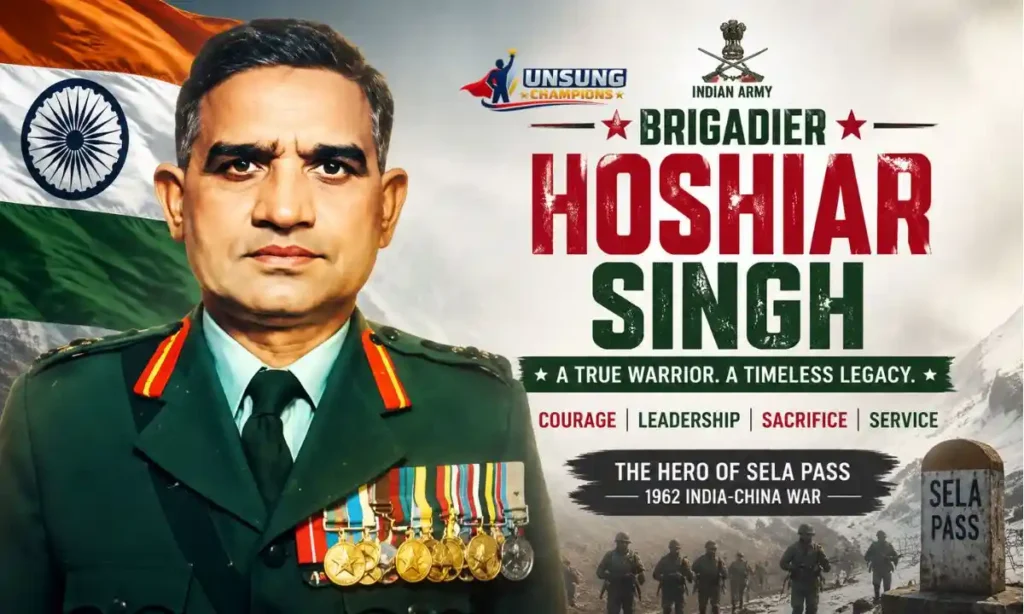
One of the bravest officers of the Indian Army, Brigadier Hoshiar Singh Rathi was the Commander of 62 Infantry Brigade during the 1962 India-China War and led troops during the defence of Sela Pass situated in the North-East Frontier Agency (now Arunachal Pradesh).
Known for his discipline, courage and leadership, Brigadier Hoshiar Singh continued fighting against heavy enemy pressure in the 1962 war. His dedication towards his soldiers and sense of duty has always been the source of motivation for many generations of the Indian Army personnel.
Born in Haryana, he had a distinguished military career, including active participation in World War II, leadership roles after the country’s independence and commanding role in one of the toughest mountain warfare situations. His sacrifice in the 1962 conflict will be remembered forever as an example of bravery and dedication to the nation. Learn more about the biography of Brigadier Hoshiar Singh Rathi, the brave Indian Army officer who commanded 62 Infantry Brigade during the 1962 India-China War. Find out information about his early life, army career, Sela Pass fight, awards, sacrifice and legacy.
Brigadier Hoshiar Singh Biography Overview
| Details | Information |
| Full Name | Brigadier Hoshiar Singh Rathi |
| Rank | Brigadier |
| Date of Birth | December 16, 1916 |
| Birthplace | Sankhol Village, Bahadurgarh, Jhajjar, Haryana |
| Date of Martyrdom | November 27, 1962 |
| Place of Martyrdom | Phudung (near Nyukmadung & Bomdila), Arunachal Pradesh |
| Service | Indian Army |
| Regiment | Rajputana Rifles |
| Famous For | Defence of Sela Pass & Command of 62 Infantry Brigade |
| War / Conflict | World War II, Sino-Indian War 1962 |
| Brigade Command | 62 Infantry Brigade |
| Key Appointments | Deputy Commandant (NDA Khadakwasla) |
| Awards & Honours | Croix de Guerre (French War Cross), Mentioned in Despatches |
| Nationality | Indian |
Who Was Brigadier Hoshiar Singh?
Brigadier Hoshiar Singh Rathi was a senior Indian Army officer who had devoted his life to the military service. He belonged to that generation of soldiers who served India before and after its independence.
During his military career, Brigadier Hoshiar Singh proved his exceptional leadership qualities and steadily climbed the ranks thanks to his professionalism, courage and experience in operations.
His greatest achievement was in the 1962 India-China War when he commanded 62 Infantry Brigade defending Sela Pass. This region was strategically important since the control over it was necessary for the protection of routes in the eastern Himalayan sector.
Early Life and Childhood
Brigadier Hoshiar Singh was born on December 16, 1916 in Sankhol village, near Bahadurgarh, Haryana. He came from the family with a strong military tradition.
Growing up in rural Haryana, he acquired such qualities as determination, physical fitness and responsibility which were helpful in building up a successful military career.
In the period when joining the armed forces required immense dedication and discipline, young Hoshiar Singh chose the way of military service and became an officer of the Indian Army.
Family Background
Brigadier Hoshiar Singh came from a traditional Haryana family with a strong martial tradition. His family had a huge influence on shaping up the values which were typical for his military career.
They have seen his growth from a young village boy into a respected Army commander who commanded soldiers during one of the toughest Indian wars.
Family Details
| Family Information | Details |
| Family Origin | Sankhol Village, Bahadurgarh, Haryana |
| Background | Traditional Haryanvi Family with Army Values |
| Cultural Heritage | Martial Tradition of Rural Haryana |
| Children & Descendants | Family details kept private in historical archives |
| Legacy | Remembered through military history, local memorials & infrastructure |
Brigadier Hoshiar Singh Education
Little is known in the public sources about the early education of Brigadier Hoshiar Singh. However, like many officers of his generation, he got military-oriented education which prepared him for the leadership role in the Indian Army.
His professional military development allowed him to get experience in operations and acquire skills which turned out to be very valuable during various operations throughout his decades-long career.
Joining Indian Army
Brigadier Hoshiar Singh joined the Indian Army in the pre-independence period and became a member of the Rajputana Rifles, one of the oldest infantry regiments of the Indian Army.
His early military career acquainted him with different operation environments which helped him get profound knowledge of warfare, troop management and strategy in the battlefield.
Throughout his years, his dedication and leadership qualities helped him reach senior command positions.
Military Career Timeline
| Year/Period | Career Milestone |
| 1916 | Born in Sankhol Village, Bahadurgarh, Haryana |
| 1930s | Joined Indian Army and commissioned into Rajputana Rifles |
| 1939–1945 | Served during World War II in overseas campaigns |
| 1947 | Continued service in independent India’s Army post-partition |
| 1950s | Appointed as Deputy Commandant of National Defence Academy (NDA) |
| 1962 (Mid) | Took command of 62 Infantry Brigade in NEFA |
| 1962 (Nov) | Commanded 62 Infantry Brigade during Sela Pass Battle |
| 27 Nov 1962 | Martyred during Chinese ambush at Phudung, Arunachal Pradesh |
Brigadier Hoshiar Singh Military Career and Achievements
Brigadier Hoshiar Singh Rathi had a splendid military career reflecting discipline, courage and exceptional leadership. Having served during the pre-independence and post-independence periods, he acquired extensive experience in operations and became one of the respected commanders of the Indian Army.
It took him not only promotion and rank but decades of dedication, professional knowledge and leadership skills to become a great commander.
Service During World War II
Before India became independent, Brigadier Hoshiar Singh served in the British Indian Army during the period of the Second World War. This period provided him with valuable experience in international warfare, military planning and operation in the battlefield.
During the World War II, Indian soldiers took part in many campaigns in different regions. Service in such difficult environments helped officers like Hoshiar Singh to acquire professional military skills which turned out to be extremely valuable after independence.
His experience during this period strengthened his understanding of:
- Battlefield strategy
- Troop management
- Combat planning
- Leadership under pressure
- Operational decision-making
Rajputana Rifles: The Foundation of His Army Career
Brigadier Hoshiar Singh was associated with the reputable Rajputana Rifles, one of the oldest infantry regiments of the Indian Army.
This regiment has a long history of bravery and has made an important contribution to military operations of India. Service in such an acclaimed regiment allowed Brigadier Hoshiar Singh to develop his leadership abilities and military expertise.
Throughout his career, he remained committed to the traditions of the regiment:
- Courage on the battlefield
- Loyalty towards the nation
- Discipline and professionalism
- Leading soldiers by example
Awards and Honours Before the 1962 War
Prior to the final battle during the India-China War, Brigadier Hoshiar Singh had already gained recognition for his military service and bravery.
During the World War II, his leadership under enemy fire won him the foreign gallantry award Croix de Guerre (French War Cross). His professional achievements reflected his contribution to the armed forces throughout decades.
Awards and Recognitions
| Award / Honour | Details |
| Croix de Guerre | French wartime military honour for World War II bravery |
| Mentioned in Despatches | Official recognition for commendable military performance |
| General Service Medal 1947 | Awarded for post-independence military service |
| WWII Service Medals | Campaign honors for overseas combat operations |
Post-Independence Army Career
After India’s independence in 1947, Brigadier Hoshiar Singh continued serving in the newly formed Indian Army.
The post-independence period was a challenging time for the Indian military, as the Army was reorganizing and preparing for new security challenges. Officers like Brigadier Hoshiar Singh played an important role in maintaining military readiness and strengthening the Army’s operational capabilities.
Over the years, he handled increasing responsibilities and proved his ability as a senior commander.
His career included:
- Command responsibilities
- Training roles
- Administrative duties
- Strategic planning assignments
- Leadership of Army formations
Role as NDA Deputy Commandant
One of the important positions held by Brigadier Hoshiar Singh was serving as the Deputy Commandant of the National Defence Academy (NDA) located in Khadakwasla, Pune.
The NDA is the premier military academy responsible for the training of future officers of the Army, Navy, and Air Force.
As Deputy Commandant, he contributed to:
- Officer training
- Leadership development
- Military discipline
- Preparing future defence leaders
Command of 62 Infantry Brigade
The most significant period of Brigadier Hoshiar Singh’s career was when he was appointed the commander of 62 Infantry Brigade.
The brigade had to defend the strategically important region of Sela Pass during the 1962 India-China War.
The region was extremely challenging because of:
- High altitude terrain
- Extreme weather conditions
- Difficult supply routes
- Strong enemy pressure
62 Infantry Brigade Overview
| Particular | Details |
| Brigade | 62 Infantry Brigade |
| Commander | Brigadier Hoshiar Singh Rathi |
| War | India-China War 1962 |
| Area of Operation | Sela Pass Sector (NEFA) |
| Terrain | High-Altitude Himalayan Region (Over 13,700 ft) |
| Main Challenge | Severe Chinese Military Offensive & Isolation |
India-China War 1962: Background
The 1962 India-China War was one of the most difficult conflicts experienced by independent India.
It was caused by the disagreements between India and China over border regions, especially in the Himalayan region.
The eastern sector, including present-day Arunachal Pradesh, saw intensive fight. Indian soldiers had to face many challenges, including
- Difficult mountainous terrain
- Lack of infrastructure
- Harsh weather conditions
- Strong Chinese military attacks
Defence of Sela Pass: A Strategic Responsibility
Sela Pass was strategically important location since it controlled the movement through the mountainous region into the plains of Assam.
The defence of this area was entrusted to 62 Infantry Brigade under the command of Brigadier Hoshiar Singh.
He knew the importance of this position and spared no efforts strengthening defensive arrangements. He paid attention to keeping high morale in the troops.
The battle tested:
- Leadership ability
- Tactical planning
- Soldier endurance
- Command decisions
Leadership Qualities of Brigadier Hoshiar Singh
Brigadier Hoshiar Singh was respected as a commander owing to his strong leadership qualities.
Leading From the Front
He believed that the commander should share all difficulties which his soldiers have to face. He never left his soldiers in difficult situations.
Courage Under Pressure
Even in the toughest conditions of the battlefield and under enemy artillery shelling, he remained dedicated to his duty.
Experience-Based Decisions
Many decades of military service helped him understand the situation in the battlefield and make decisions in the high altitude warfare.
Commitment to Soldiers
He always paid attention to keeping high morale in his troops.
These qualities made him an influential and respected figure among the soldiers who served under him.
Sela Pass Battle: Brigadier Hoshiar Singh’s Final Stand
he Battle of Sela Pass was one of the most difficult episodes of the 1962 India-China War. Located in the high altitude region of present-day Arunachal Pradesh, Sela Pass was a strategically important defensive position for the Indian Army.
Brigadier Hoshiar Singh Rathi, as the commander of 62 Infantry Brigade, was responsible for the defence of this critically important area against advancing Chinese forces. Faced with difficult terrain, harsh weather conditions and powerful enemy offensive, he remained devoted to his duty and bravely commanded his troops.
His actions during this battle became a symbol of determination, sacrifice and military leadership.
Strategic Importance of Sela Pass
It was considered to be an important military point due to control over the access routes in the Eastern part of Himalayas region.
Holding this position was important because:
- It provided a defensive barrier against enemy advancement.
- It protected important routes towards the Indian plains of Assam.
- It gave Indian forces a strategic advantage in mountain warfare.
However, defending the area was extremely difficult because soldiers had to operate in:
- Extremely cold weather (sub-zero temperatures)
- High-altitude conditions causing fatigue
- Difficult mountain terrain
- Limited transportation and supply facilities
Chinese Offensive During the 1962 War
In October-November 1962, the Chinese side launched a significant offensive on the Indian position along the Himalayan frontiers.
The eastern sector was characterized by tough fighting, and the Indian Army had to deal with aggressive actions of the advancing Chinese troops.
The situation became more complicated because
- Enemy forces executed outflanking movements behind Indian positions.
- Communication systems were severed due to rugged terrain.
- Mountain warfare required heavy cold-weather logistical support.
- Harsh weather conditions affected military operations.
With the help of bypassing Sela Pass to encircle the Indians at Dirang Dzong and Bomdila, the tactical situation became very complicated and forced higher command to launch a tactical retreat.
Brigadier Hoshiar Singh’s Leadership During the Battle
During the battle for Sela Pass, Brigadier Hoshiar Singh exhibited the traits of an outstanding military leader.
He focused on:
Maintaining Soldier Morale
Even in difficult times and in the process of being tactically encircled, he motivated his men to be confident and perform their duties.
Tactical Decision Making
His rich experience helped him to understand the specifics of mountain warfare and act according to changing battlefield situation.
Responsibility Towards His Men
Being a true commander, he refused to be evacuated by helicopter and marched on foot with his retreating men across the frozen path.
His leadership was the perfect example of the best traditions of the Indian Army.
Challenges Faced by the 62 Infantry Brigade
The 62 Infantry Brigade had to face many challenges during the battle.
1. Difficult Mountain Terrain
The Himalayan landscape created difficulties for movement, communication, and supplies.
2. Harsh Weather Conditions
Cold weather and snowfall affected physical abilities and performance of the soldiers.
3. Enemy Encirclement
Chinese side launched well-coordinated attacks from unexpected mountain paths, placing under great pressure the Indian defence line.
4. Limited Resources
Indian troops operated with limited ammunition and cold weather equipment having numerical superiority of the enemy.
Despite all these challenges, Brigadier Hoshiar Singh and his men showed great courage.
Brigadier Hoshiar Singh’s Final Battle
While fighting at the Sela Pass and the process of tactical retreat towards Bomdila, Brigadier Hoshiar Singh kept continuing his duty as a commander.
He kept focusing on his mission and the safety of his men. He did not give up even when battlefield situation became extremely tough.
On November 27, 1962, during the movement with a small column near Phudung village (between Dirang Dzong and Bomdila), Brigadier Hoshiar Singh and his team were ambushed by the Chinese troops occupying higher heights. Fighting until his last breath, he made the supreme sacrifice while serving his motherland.
Martyrdom of Brigadier Hoshiar Singh
Brigadier Hoshiar Singh was martyred on November 27, 1962, during the 1962 India-China War while leading his brigade in the Sela Pass sector.
His martyrdom became a symbol of courage and dedication. Though, the battle presented great challenges for the Indian side, the bravery shown by officers like Brigadier Hoshiar Singh became the bright page of India’s military history.
His life becomes an example for the future generations of the great courage, discipline, and commitment required from military.
Martyrdom Details
| Particular | Details |
| Name | Brigadier Hoshiar Singh Rathi |
| War | India-China War 1962 |
| Date of Martyrdom | November 27, 1962 |
| Location | Phudung Village (near Nyukmadung / Bomdila, Arunachal Pradesh) |
| Command | 62 Infantry Brigade |
| Service | Indian Army |
| Status | Martyred in Action (Killed in Action) |
Memorials Honouring Brigadier Hoshiar Singh
The contribution of Brigadier Hoshiar Singh is commemorated in various memorials and tributes throughout India.
His name still lives at the important sites linked to India’s military history and civil infrastructure.
Major Tributes
| Memorial / Honour | Details |
| Delhi Metro Station | Brigadier Hoshiar Singh Metro Station (Green Line, Bahadurgarh) named in his honor |
| Sankhol Memorial | Statue and memorial park built in his native village in Haryana |
| War Memorials | Name inscribed at Sela Pass & National War Memorial for 1962 sacrifice |
| Military History Archives | Remembered as a brave commander and former Deputy Commandant of NDA |
Legacy of Brigadier Hoshiar Singh
The legacy of Brigadier Hoshiar Singh goes beyond a single battle. The whole career of this brave soldier was an example of discipline, courage, and commitment to the country.
His story teaches important lessons:
- A true leader stands with his soldiers during crises.
- Courage is shown during the most difficult moments.
- Duty towards the nation comes before personal comfort and safety.
- Experience and leadership play a crucial role during military crises.
For defence aspirants and young Indians, Brigadier Hoshiar Singh remains the timeless example of service and military excellence.
Brigadier Hoshiar Singh Leadership Lessons
| Leadership Quality | Explanation |
| Courage | Faced extreme high-altitude battlefield situations without fear |
| Responsibility | Refused personal evacuation to stay on foot with his marching troops |
| Discipline | Uphold military ethos throughout his pre- and post-independence career |
| Determination | Continued duty despite heavy tactical odds and logistical challenges |
| Leadership | Inspired young cadets at NDA and soldiers during the 1962 conflict |
Lesser Known Facts About Brigadier Hoshiar Singh
- Brigadier Hoshiar Singh Rathi was born on December 16, 1916, in Sankhol village, Haryana.
- He served in the Indian Army during both the pre-independence (World War II) and post-independence periods.
- He belonged to the elite Rajputana Rifles regiment.
- He served in World War II combat operations overseas and was decorated with the French Croix de Guerre.
- He served as the Deputy Commandant of the prestigious National Defence Academy (NDA) at Khadakwasla.
- He commanded the 62 Infantry Brigade during the 1962 India-China War.
- He refused special transport during the Sela Pass retreat, choosing to walk through snow with his men.
- He attained martyrdom on November 27, 1962, at Phudung village in Arunachal Pradesh.
- A major Delhi Metro terminal station in Bahadurgarh, Haryana, is officially named after him.
Brigadier Hoshiar Singh Family Details and Personal Life
Brigadier Hoshiar Singh Rathi spent the majority of his life serving the nation. As he belonged to the generation of the Army officers prior to independence, there is not much information about his private life in the public archives.
But it is known that he belonged to the traditional Haryana family where discipline, courage, and dedication were highly valued. His family background played an important role in shaping the qualities which made him an excellent military commander.
His family saw how he moved from a young village boy from Sankhol to the senior Indian Army officer commanding troops in one of the toughest battles of India.
Family Overview
| Details | Information |
| Full Name | Brigadier Hoshiar Singh Rathi |
| Family Origin | Sankhol Village, Bahadurgarh, Haryana |
| Background | Traditional Haryanvi Family |
| Profession | Indian Army Officer |
| Personal Life Details | Kept private; preserved in local & army records |
| Legacy | Remembered as a Brave Indian Army Commander |
Brigadier Hoshiar Singh Awards and Honours
During his long military career, Brigadier Hoshiar Singh was awarded with many prestigious awards and honours for his excellent services to the Armed Forces.
His awards reflected his bravery during wartime, professional excellence, and dedication towards military service.
Awards and Recognitions
| Award / Honour | Details |
| Croix de Guerre | International wartime honor awarded by France for WWII leadership |
| Mentioned in Despatches | Recognition for outstanding military performance |
| General Service Medal 1947 | Post-independence operational recognition medal |
| World War II Medals | WWII campaign service recognitions |
Brigadier Hoshiar Singh Military Achievements
Brigadier Hoshiar Singh’s achievements were not limited to just one battle. His whole career was the example of decades of commitment, leadership, and professionalism.
Some of his major achievements include:
- Serving in the Indian Army during the pre-independence era.
- Gaining valuable battlefield experience during World War II.
- Rising through the ranks in the Rajputana Rifles.
- Serving as Deputy Commandant of the National Defence Academy (NDA).
- Commanding the important 62 Infantry Brigade in NEFA.
- Leading Indian troops with courage during the 1962 India-China War.
- Becoming remembered as one of the brave commanders of the Sela Pass defence.
His career tells the story of an officer who was constantly taking up bigger responsibility throughout his career.
Brigadier Hoshiar Singh Salary
Brigadier Hoshiar Singh was an Indian Army Officer during the time when military salaries were based on the government pay scales applicable in the 1950s and 1960s.
Having the rank of Brigadier, his salary was comprised of:
- Basic military pay
- Rank-based allowances
- Service benefits
- Government-provided housing and operational facilities
Salary Information
| Particular | Details |
| Rank | Brigadier |
| Organization | Indian Army |
| Service Period | 1930s – 1962 |
| Salary Source | Government of India Military Pay Structure (1960s) |
| Exact Salary | Not Publicly Disclosed |
Brigadier Hoshiar Singh Net Worth
There is no financial information available about the net worth of Brigadier Hoshiar Singh.
During his lifetime, Army Officers were known mainly for their service, honour, and dedication rather than for public financial standing. His legacy is determined through his military services and respect he gained as a commander.
Net Worth Details
| Category | Information |
| Net Worth | Not Applicable / Not Disclosed |
| Main Income Source | Indian Army Salary & Military Allowances |
| Profession | Military Service |
| Legacy Valuation | Measured by National Honor & Battlefield Sacrifice |
Brigadier Hoshiar Singh Social Media Presence
Brigadier Hoshiar Singh lived in the pre-internet era without the existence of social media. That is why he did not have any social media accounts.
Nowadays, defense enthusiasts, military historians, and government handles promote his heroic deeds using the digital space.
Social Media Status
| Platform | Status |
| No Official Account (Historical Personality) | |
| Tribute Pages & Army Posts Available | |
| X (Twitter) | Tribute Posts by Ministry of Defence / Veterans |
| YouTube | Historical Documentaries & Biographies Available |
| No Account |
Why Brigadier Hoshiar Singh Is Remembered Today?
Brigadier Hoshiar Singh is remembered because his life was an example of the finest military traditions and self-sacrifice.
His story is still inspirational due to the following reasons:
- He served the nation honorably across multiple historical phases (WWII & 1962 War).
- He showed extraordinary calmness and leadership during high-altitude combat.
- He led young cadets at NDA and soldiers during India’s most challenging military crisis.
- He refused personal comfort and remained committed to his duty until his final breath.
Conclusion
The life of Brigadier Hoshiar Singh Rathi is an example of courage, leadership, and selflessness. From his childhood in rural Haryana to the Deputy Commandant of NDA and to the senior Commander of the Indian Army, his life tells the story of the finest qualities of discipline, responsibility, and service.
His role as the commander of 62 Infantry Brigade during the 1962 India-China War remains the most heroic page of Indian military history. Having faced the challenges of the high altitude climate and tactical encirclement, he stood by his men until his last breath.
The legacy of Brigadier Hoshiar Singh lives through generations of soldiers, defence aspirants, and proud citizens of India. His name will remain among the greatest military leaders of India who put their duty above everything else.
FAQs
1. Who was Brigadier Hoshiar Singh?
Brigadier Hoshiar Singh Rathi was a senior Indian Army officer who commanded the 62 Infantry Brigade during the 1962 India-China War and led the defence of the Sela Pass sector in NEFA.
2. When was Brigadier Hoshiar Singh born?
Brigadier Hoshiar Singh was born on December 16, 1916, in Sankhol village, Bahadurgarh, Haryana.
3. Which regiment did Brigadier Hoshiar Singh belong to?
He served with the prestigious Rajputana Rifles of the Indian Army.
4. What was Brigadier Hoshiar Singh famous for?
He is remembered for his tactical leadership during the Sela Pass defence, serving as Deputy Commandant of the NDA, and making the supreme sacrifice during the 1962 War.
5. Which brigade did Brigadier Hoshiar Singh command?
He commanded the 62 Infantry Brigade during the 1962 India-China War.
6. What awards did Brigadier Hoshiar Singh receive?
He received the French wartime honor Croix de Guerre during World War II, along with Mentioned in Despatches and campaign service medals.
Also, Read About: Major Kuldeep Singh Biography: Battle of Longewala Hero, Age, Wife, Family, Army Career & Maha Vir Chakra